ABM vs Demand Gen in 2026: How to Split Your Budget
ABM vs demand gen in 2026, compared as go-to-market motions, with a clear way to split budget between the two by your TAM, ACV, and sales motion.
The honest framing of ABM vs demand gen is that it was never a versus, and treating it as one is among the most expensive mistakes in B2B. These are not two competing teams you pick between. They are two motions that do different jobs at different points of the funnel, and the only real question is how you split the budget between them for the market you actually sell into.
Demand generation creates and captures interest across a broad audience to fill the funnel at scale. Account-based marketing concentrates resources on a defined list of high-value accounts and surrounds them with personalized, multi-channel effort. Demand gen fuels the market; ABM converts the priority accounts. By the numbers, demand generation still drives the majority of B2B pipeline, while ABM tends to lift win rates and deal size inside a focused target list. Most leading teams run both under one set of revenue goals, so the operator skill is not choosing a side, it is setting the ratio.
This guide treats ABM vs demand gen as a budget-allocation decision rather than a debate, with a concrete way to set your split by total addressable market, average contract value, and sales motion. It sits inside the account-based marketing cluster, alongside the category-level best abm tools guide, and it maps directly onto how outbound sales is funded and run.
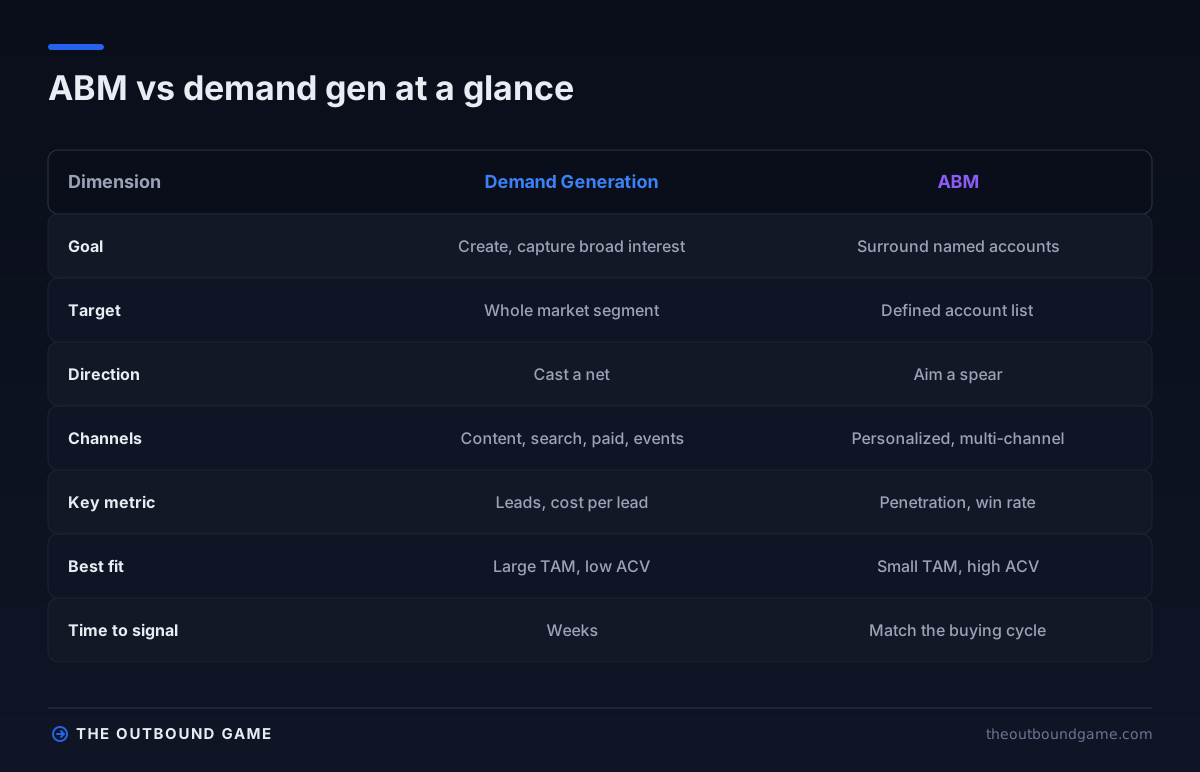
Quick verdict: ABM vs demand gen
If you only read one section, read this one.
- Lean demand-gen-heavy if you sell to a large addressable market at a lower contract value with a shorter, often self-serve or product-led cycle. Volume is your friend.
- Lean ABM-heavy if you sell to a small, well-defined market at a high contract value with long cycles and large buying committees. Precision pays.
- Run a balanced split if you are in the middle, most companies are, and use demand gen to create the market while peeling your best-fit accounts into a dedicated ABM track.
- Never run pure ABM against a huge list, and never judge ABM by lead volume. Those two errors waste more budget than choosing the “wrong” motion ever could.
The rest of this guide shows the math behind that split and how to run both motions without one starving the other.
ABM vs demand gen: the core difference
The fundamental difference is direction. Demand generation pushes outward to a broad audience and pulls qualified buyers from the volume. ABM starts from a named list and builds every touch around those specific accounts. One casts a net, the other aims a spear.
That difference cascades into everything else. Demand generation is measured on volume and efficiency: traffic, marketing-qualified leads, cost per lead, pipeline created across the whole market. It leans on content, search, paid media, webinars, and email, and it is the engine behind classic lead generation. Account-based marketing is measured on penetration and quality: how many target accounts you are engaging, pipeline from that list, and win rate inside it. It leans on tight sales and marketing alignment, intent data, and personalized outreach across channels.
Neither is universally better, and framed the other way, demand gen vs abm lands on the same conclusion: they serve different business models, different ideal customer profiles, and different revenue math. A clearly defined ICP is the shared foundation. Get the ICP right and both motions sharpen; get it wrong and both waste money. If you want the platform-level view of how the ABM side gets operationalized, the demandbase vs 6sense comparison covers the two enterprise options, and the b2b data providers layer feeds account selection for either motion.
When demand generation wins
Demand generation is the right lead motion when volume works in your favor.
It fits a large total addressable market, a lower average contract value, and a shorter buying cycle, including self-serve and product-led growth models where a single buyer can evaluate and purchase without a committee. When there are tens of thousands of potential customers and the deal size cannot justify bespoke, per-account effort, you need reach and efficiency, not precision. Demand generation also does the unglamorous early work no ABM program can skip: it builds the brand awareness and category presence that make later account-based outreach land warm instead of cold.
In practical terms, this is where search, content, paid social, and scaled email earn their keep, and where a healthy b2b prospecting motion converts inbound interest into qualified conversations.
When ABM wins
Account-based marketing is the right motion when a single account is worth surrounding.
It fits a small, well-defined market, a high average contract value, long sales cycles, and large buying committees where you must reach six or more stakeholders inside one organization. In the enterprise and upper mid-market, a well-run abm strategy tends to deliver higher deal velocity and stronger win rates than broad demand gen alone, because the effort concentrates where the revenue is. This is also the motion that disciplined outbound sales serves best, since named-account targeting and personalized sequences are exactly what ABM asks for.
The catch is scale. ABM is expensive per account, so it only pays when the contract value justifies the effort and the list is short enough to execute against properly. Run it against a list of fifty thousand accounts and it stops being ABM.
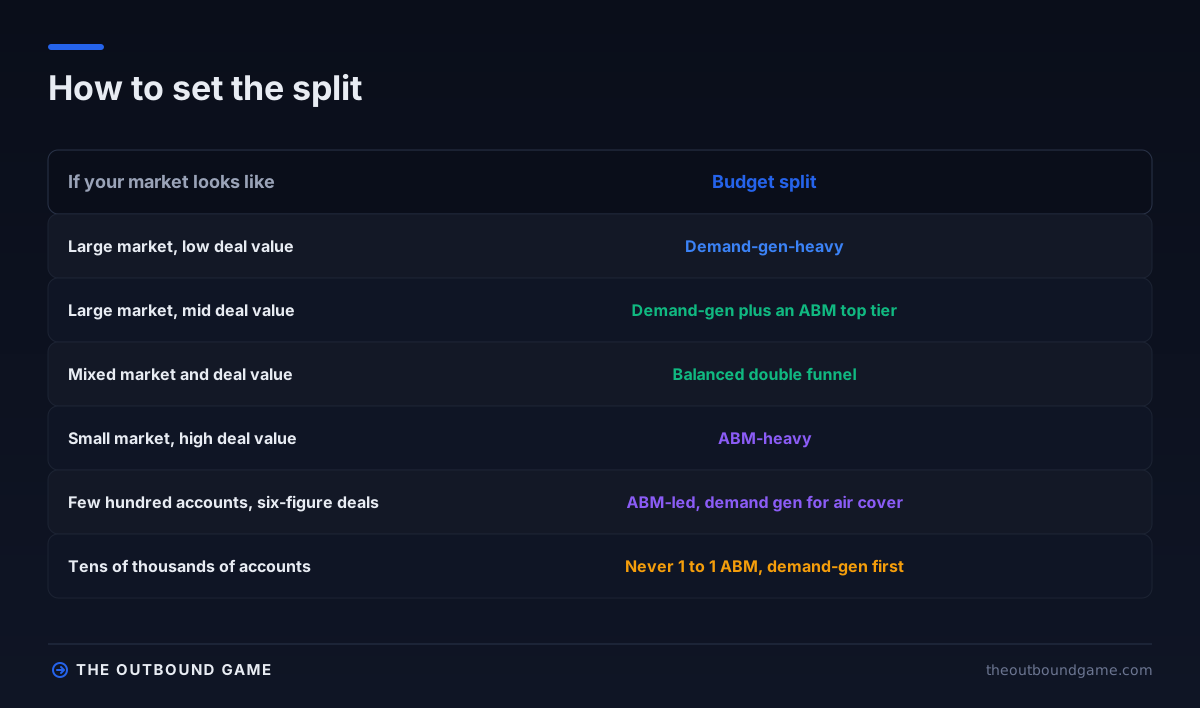
How to set the split: the TAM and ACV math
The allocation is not a gut call. Two variables decide most of it: how big your addressable market is, and how much a deal is worth.
Hold average contract value high and total addressable market small, and the math pushes you toward ABM, because each account can absorb real per-account investment and there are few enough to cover. Hold contract value low and addressable market large, and the math pushes you toward demand generation, because no single deal justifies bespoke effort and only volume scales. Most companies sit between those poles and should run a deliberate blend, with the dial set by which way their numbers lean.
A useful sanity check: divide your realistic annual marketing budget by the number of accounts you would need to truly surround in an ABM program. If that per-account number is too small to fund meaningful, sustained, multi-channel touches, your list is too long for the budget and you are really a demand-gen-first business that should reserve ABM for a top tier. Roughly three-quarters of leading B2B companies run both motions under unified revenue goals rather than picking one, and surveys consistently show the integrated teams outperform either motion run alone. You can pressure-test category definitions and vendor fit on G2 and against the analyst view from Gartner before you commit spend.
The double funnel: running both without conflict
In 2026 the highest-performing teams do not silo the two motions. They run a double funnel.
A broad demand generation engine keeps the brand visible and captures the in-market buyers who raise their hand, the low-hanging fruit. From that same funnel, the highest-value, best-fit accounts get peeled off and moved into a dedicated ABM track that surrounds the buying committee with personalized outreach and intent-triggered touches. Demand gen keeps you fed while the longer account-based plays mature, so you are not starving while you hunt the larger deals.
The mechanics that make this work are shared, not duplicated. One ICP governs both. The same b2b data providers and enrichment feed both account selection and lead scoring. Intent signals route in-market accounts from the broad funnel into the focused track. Demand generation content gets reused as the personalized fuel for ABM sequences. The defining guidance from analysts and operators alike is integration, not opposition, and the teams that treat it as one revenue engine outperform the teams still arguing about which motion to fund. HubSpot’s own demand generation framing reflects the same shift toward a unified, full-funnel system.
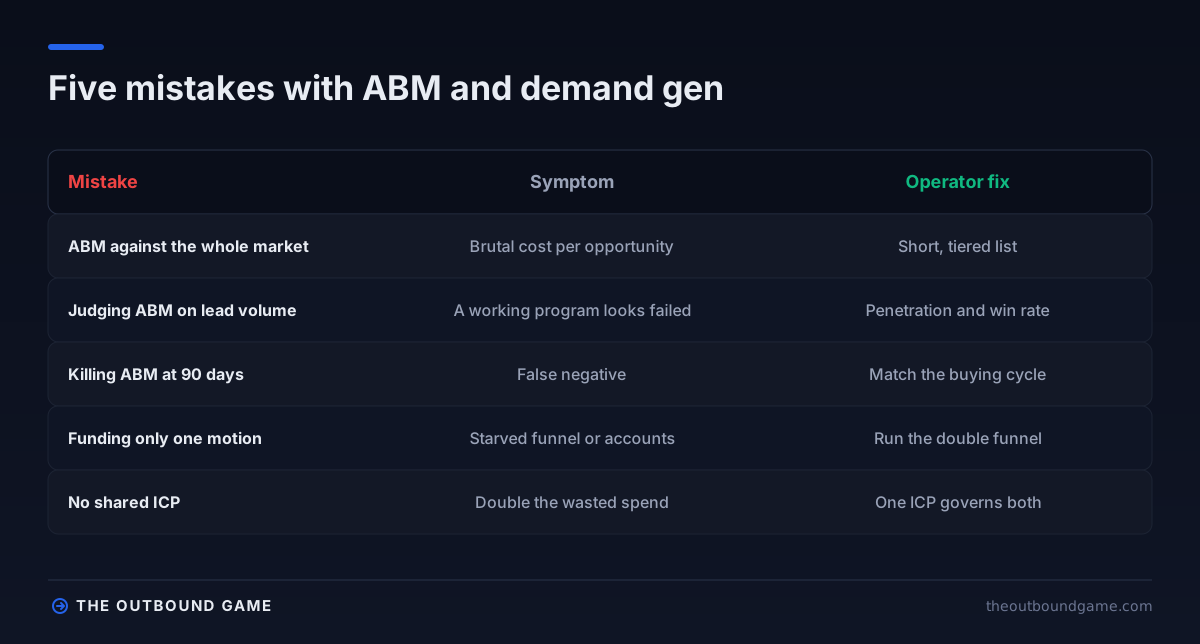
Five mistakes teams make with ABM vs demand gen
What we see most often is the same handful of errors that waste budget regardless of which motion is technically “right.”
-
Running ABM against the whole market. A company with tens of thousands of potential customers tries one-to-one ABM against all of them and burns cash. ABM needs a short, tiered list.
-
Judging ABM by lead volume. If you evaluate an account-based program on raw leads, you are using a demand-gen metric. Measure account penetration, pipeline from the target list, and win rate inside it.
-
Killing ABM before the cycle completes. Enterprise ABM against twelve-month buying cycles takes about twelve months to show results. Evaluating it at ninety days guarantees a false negative.
-
Funding only one motion. Pure demand gen leaves your best accounts under-served; pure ABM starves the top of funnel and the brand awareness that warms future outreach.
-
Skipping the shared ICP. Running the two motions off different definitions of a good-fit account doubles the waste. One ICP should govern both.
An eight-step framework for allocating between the two
Run this order before you set next quarter’s budget.
- Define one ICP. Write a single ideal customer profile that governs both motions, since a shared definition is the foundation for each.
- Size your market. Estimate your realistic total addressable market, because its size is the first input to the split.
- Anchor on contract value. Take your average contract value, since high ACV justifies per-account effort and low ACV demands volume.
- Run the per-account math. Divide a realistic budget by the accounts you would truly surround, and check whether the per-account spend funds real touches.
- Set the starting ratio. Place yourself on the demand-gen-heavy to ABM-heavy scale based on steps two and three, and write the split down.
- Wire the double funnel. Connect demand gen to ABM so in-market accounts route from the broad funnel into the focused track.
- Split the metrics. Measure demand gen on volume and efficiency, measure ABM on penetration, target-account pipeline, and win rate, and never cross them.
- Give each motion its own clock. Judge demand gen on a short feedback loop and ABM on the length of the buying cycle, then rebalance the ratio with real data.
How this choice fits the broader stack
The allocation decision sits on top of the same outbound and revenue infrastructure either motion needs. Each layer has a deeper guide.
- The strategy. What the ABM motion actually is, in the account-based marketing pillar.
- The tools. The platforms that run the account-based side, in best abm tools and the demandbase vs 6sense comparison.
- The data layer. Fit and contact data that feeds both motions, in b2b data providers and data enrichment tools.
- Intent and research. The signals that route accounts into the focused track, in sales intelligence tools.
- The system of record. Where pipeline from both motions lives, in crm software.
- The channels. How accounts and leads get engaged, in cold email software, linkedin outreach, and sales engagement.
- The cadence. How touches are sequenced for the ABM track, in sales cadence.
- Deliverability. Whether any of the outreach is ever seen, in email deliverability.
The map is consistent: one ICP feeds both motions, demand generation creates and captures broad interest, ABM concentrates resources on the accounts worth surrounding, and shared data and deliverability hold the whole engine together. The budget split is the lever, and it should be set by your market, not by a debate.
Frequently asked questions
What is the difference between ABM and demand generation?
Is ABM better than demand generation?
How do I decide how much budget to put into ABM vs demand gen?
Can you run ABM and demand generation at the same time?
What metrics should I use for ABM versus demand generation?
How long does ABM take to show results compared to demand generation?
Does ABM replace lead generation?
The bottom line
ABM vs demand gen is the wrong question phrased as a fight. Demand generation creates and captures interest at scale and drives most of the pipeline for most B2B companies; account-based marketing concentrates resources on the accounts worth surrounding and lifts win rates where the deals are large. They are complementary motions, not rivals, and the only decision that matters is the split.
Set that split with the math, not the debate. Size your market, anchor on contract value, run the per-account check, and let the numbers place you on the scale from demand-gen-heavy to ABM-heavy. Then wire the two into one double funnel under a single ICP, give each motion its own metrics and its own clock, and rebalance with real data. Do that and the versus disappears, because you stop choosing between the two and start funding each for the job it is actually good at.
Get the operator playbook in your inbox. The Outbound Game publishes one operator-grade breakdown a week on B2B outbound sales, tactics, tooling, and ops. No fluff, no vendor talking points. Subscribe and get the next one when it ships.
More on Outbound Strategy
Cold Email vs LinkedIn Outreach: Which Wins in 2026?
Cold email vs LinkedIn outreach in 2026: the reply rate and cost data, the volume caps, when each channel wins, and the combined sequence that beats both.
How to Start Outbound Sales in 2026 (60 Day Roadmap)
How to start outbound sales from zero in 2026: the 60 day roadmap from ICP to first meetings, the starter stack, and the metrics that prove the channel.
LinkedIn Connection Request Message: What Works in 2026
LinkedIn connection request message guide for 2026: the note paradox, the 120 to 180 character sweet spot, and the acceptance rate math that gates volume.