The Best B2B Data Providers in 2026: An Operator Guide
The best B2B data providers in 2026, compared on accuracy not database size. An operator guide to coverage, compliance, and the real pricing.
The best B2B data providers in 2026 are not the ones advertising the biggest database; they are the ones whose data actually connects you to a buyer for your specific ICP. That distinction is where money is won or lost. A team spends 20,000 dollars on B2B contact data, and six months later nearly a quarter of those contacts have bounced, changed roles, or left their companies, because B2B data decays at roughly 3 percent a month and independent testing shows most providers deliver only about 50 percent accuracy on average. The gap between “millions of contacts” and “contacts that reach a real person” is the entire game, and database size tells you nothing about it.
This is the pillar reference for the data layer, the foundation every outbound channel sits on. The providers all make the same promises, more accurate data, better coverage, faster enrichment, so the buyer’s real job is to cut through the claims and evaluate on the axes that actually predict results: verified accuracy for your segments, coverage by geography and ICP, compliance posture, and the true cost once credits and seats are counted. Get the data layer right and email, phone, and LinkedIn all improve at once; get it wrong and every downstream channel inherits the decay.
The providers here overlap with the sales intelligence tools category and feed the data enrichment tools layer that keeps records fresh. This guide is the how-to-choose layer underneath both, and the data that powers the B2B prospecting workflow downstream, covered in sales prospecting.
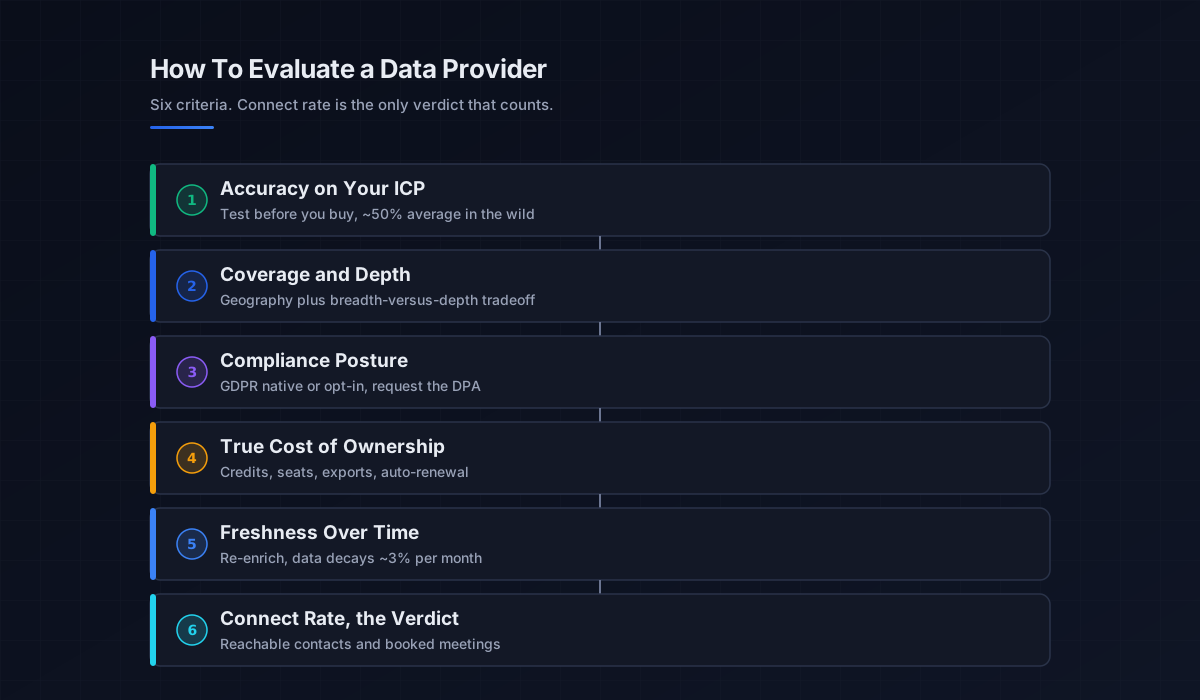
How to evaluate a B2B data provider
Before any vendor comparison, fix the evaluation criteria, because the providers compete on broadly similar promises and the differences hide in the details. Four axes decide the choice.
Accuracy, the axis that matters most
Every provider claims 95-percent-plus accuracy; few deliver it on your list. Independent Q1 2026 testing on mixed contacts put waterfall tools highest and single-source databases lower, ZoomInfo around 84 percent, Apollo near 78 percent, with most providers averaging closer to 50 percent in the wild. The only number that matters is accuracy measured on your own ICP, so the rule is to test before you commit. A b2b data provider that scores well on tech companies can fall apart on healthcare.
Coverage and the depth tradeoff
Coverage splits two ways: geography and the breadth-versus-depth tradeoff. Some providers hold 300 million-plus contacts but thin data on each, while others hold fewer records with deeper firmographics and technographics. For North American outbound, ZoomInfo and Apollo lead on breadth; for European buyers, coverage thins fast outside specialist providers. Match the coverage map to where your buyers actually are, not to the headline record count.
Compliance posture
Compliance varies more than buyers expect. Cognism and waterfall specialists publish GDPR documentation and DPAs by default, while ZoomInfo, Apollo, and Lusha offer compliant configurations you must opt into. For regulated industries or European selling, native compliance is not optional, and the rule is simple: always request the DPA before signing.
True cost, not the headline price
The advertised price is rarely the real price. Most providers sell on credits, where a mobile reveal costs more than an email and exports burn credits too, and per-seat pricing means a five-person team on an enterprise database can run 40,000 to 80,000 dollars a year. Run a usage projection before signing, and watch for aggressive auto-renewal clauses that lock teams into 30,000-dollar renewals when they miss the cancellation window.
The leading B2B data providers by fit
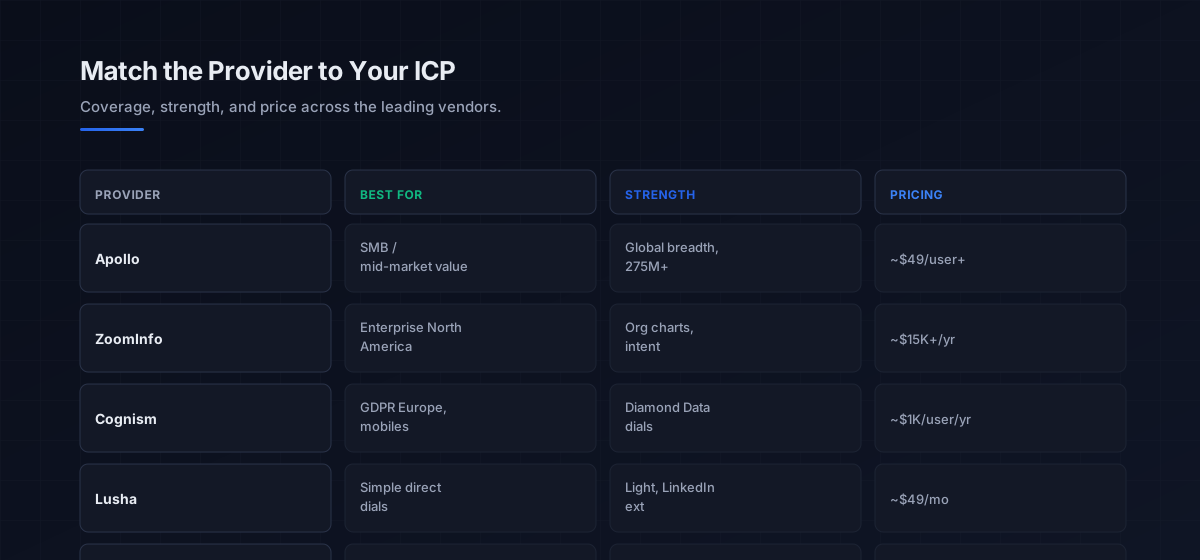
With the axes clear, here are the providers teams actually reach for, grouped by who they fit. Pricing is current for 2026.
For SMB and mid-market value, Apollo is the obvious starting point, a contact database plus sequencing with a genuine free tier and paid plans from around 49 dollars a user, holding 275 million-plus contacts with strong global breadth. The trade-offs: accuracy near 78 percent that runs higher outside the US, per-seat pricing that scales linearly to roughly 10,000 dollars a year for a team of ten, and a UI-first design that makes it a better self-serve prospecting tool than a raw data source for custom pipelines.
For enterprise North American depth, ZoomInfo is the default, the broadest single-source database with org charts, intent, and conversation intelligence, from around 15,000 dollars a year. For GDPR-compliant European data and phone-verified mobiles, Cognism owns the gap ZoomInfo and Apollo struggle with, its Diamond Data product offering human-verified numbers with high connect rates, typically around 1,000 dollars per user a year. For simple, verified direct dials, Lusha is the lightest option from around 49 dollars a month, and for API-first data infrastructure at scale, People Data Labs prices per record near a cent. For maximum accuracy across segments, a waterfall approach through Clay chains providers to beat any single source.
Single provider vs waterfall
The architectural choice underneath provider selection is whether to rely on one database or chain several. A single provider is simpler to buy and manage, and for a team selling into one well-covered segment it can be enough. The weakness is coverage gaps: every database covers some segments and regions poorly, and a single source leaves those records unenriched or wrong.
Waterfall fills the gaps by querying providers in sequence, primary first, then fallbacks for the misses, which independent testing shows consistently beats single-source databases on email accuracy. The cost is complexity and credit consumption, since failed lookups still cost money and the orchestration needs setup. The practical rule, covered in depth in the data enrichment tools guide, is to pair a high-accuracy primary database with a waterfall layer for the gaps: verified contacts up front, fallback fill for everything the primary misses. That hybrid usually beats both a lone database and a pure waterfall.
How B2B data connects to the outbound stack
A b2b data provider supplies the raw material, but data only produces pipeline when it flows into outreach accurately and stays fresh. The verified emails feed the sales prospecting workflow and the cold email sequences behind it, kept inbox-safe per email deliverability practice; the phone-verified direct dials decide connect rates on the cold calling channel, where bad data produces the 200-dials-per-meeting problem; and because LinkedIn Sales Navigator withholds email export, a data provider or enrichment layer is what makes those lists reachable for LinkedIn automation tools.
This is the through-line of the whole site: every channel is downstream of the data, and the data decays continuously. Sales data providers solve the sourcing half, enrichment solves the freshness half, and sales intelligence tools add the timing signals on top. Buy the provider whose accuracy and coverage fit your ICP, keep it fresh with enrichment, and the same clean data lifts every channel at once.
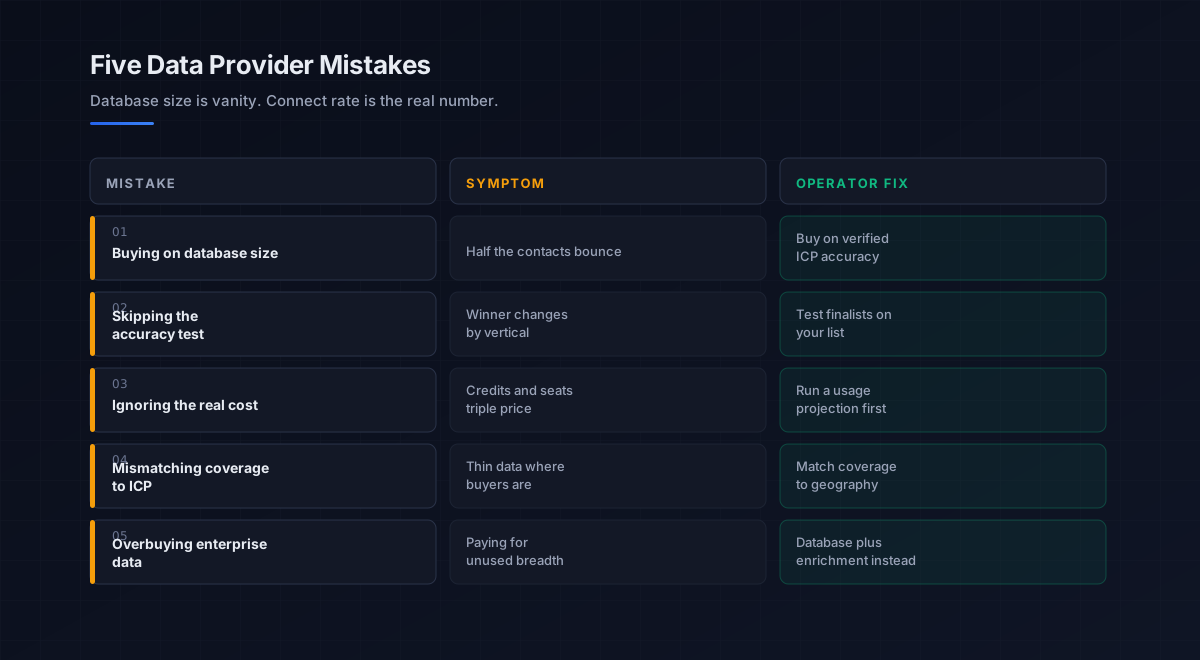
Five mistakes teams make choosing B2B data providers
What we see most often is the same handful of errors that waste data budget.
-
Buying on database size. Millions of contacts means nothing if half bounce. Buy on verified accuracy for your ICP, not raw record count.
-
Skipping the accuracy test. Every vendor claims 95 percent; few hit it on your list, and the winner changes by vertical. Test finalists on your own records before signing.
-
Ignoring the real cost. Credits for mobile reveals and exports, plus per-seat pricing, can triple the headline. Run a usage projection and read the auto-renewal clause.
-
Mismatching coverage to ICP. A North American database is thin in EMEA and vice versa. Match the provider’s coverage map to where your buyers actually are.
-
Overbuying enterprise data. Below enterprise deal sizes, a verified database plus enrichment beats a 50,000-dollar platform you barely use. Match the spend to deal value.
An eight-step framework for choosing a B2B data provider
This is the order we work through with the teams we work with when they pick a data provider. Run it before buying anything.
- Define your ICP and geography. Know exactly who and where your buyers are before judging any provider’s coverage.
- Shortlist by coverage fit. ZoomInfo or Apollo for North America, Cognism for EMEA, People Data Labs for API scale.
- Test accuracy on your own list. Run the same sample through finalists and measure connect-worthy accuracy on your data.
- Check compliance. Request the DPA and confirm GDPR posture, native for EMEA, opt-in elsewhere, before signing.
- Model the true cost. Project credit usage for mobiles and exports, count seats, and factor integration fees and auto-renewal.
- Decide single vs waterfall. Single provider for one covered segment, a primary plus waterfall for a mixed or international ICP.
- Plan for freshness. Pair the provider with an enrichment layer and a re-enrichment cadence, since data decays about 3 percent a month.
- Judge on connect rate, not record count. Measure the provider on meetings and reachable contacts, not the size of its database.
How B2B data providers fit the broader stack
Data is the foundation under every outbound channel. Each connects to a deeper guide.
- Data accuracy. Keeping records fresh as they decay, in data enrichment tools.
- Intent and insight. Adding timing signals on top of contact data, in sales intelligence tools.
- Prospecting. The workflow the data feeds, in best AI tools for sales prospecting.
- The phone channel. Where verified dials decide connect rates, in the cold calling pillar.
- LinkedIn targeting. Making Sales Navigator lists reachable, in LinkedIn Sales Navigator.
- The wider AI stack. All six categories of sales AI in best AI sales tools.
- Strategy. The motion the data serves, in outbound sales.
- Email coordination. Keeping the email channel clean, on email deliverability and sender reputation.
That is the map. The provider sources verified contact and company data, enrichment keeps it fresh, intelligence adds the timing, and the channels turn accurate, current data into booked meetings, all of them only as good as the data underneath.
Frequently asked questions
What are the best B2B data providers in 2026?
How accurate is B2B contact data?
How much do B2B data providers cost?
Which B2B data provider is best for Europe?
Do I need a B2B data provider if I have enrichment tools?
Should I use one B2B data provider or several?
Why is so much of my purchased B2B data wrong?
The bottom line
The best B2B data providers in 2026 are the ones whose data is accurate for your ICP and stays fresh, not the ones with the largest database. Evaluate on the four axes that predict results, accuracy on your segments, coverage by geography, compliance posture, and true cost once credits and seats are counted, then match the vendor to your buyers: Apollo for value, ZoomInfo for enterprise North America, Cognism for compliant Europe, and a waterfall layer for the gaps any single source leaves.
If you take one rule from this pillar, make it this: database size is a vanity metric, connect rate is the real one. Test providers on your own list, buy for accuracy and coverage that fit your ICP, pair the database with enrichment to fight the 3-percent monthly decay, and judge the provider on reachable contacts and booked meetings rather than the headline record count. Get the data layer right and every channel downstream gets better at the same time.
Get the operator playbook in your inbox. The Outbound Game publishes one operator-grade breakdown a week on B2B outbound sales, tactics, tooling, and ops. No fluff, no vendor talking points. Subscribe and get the next one when it ships.
More on Data Providers
Apollo vs Cognism in 2026: Which Data Platform to Buy
Apollo vs Cognism compared for 2026: real pricing, EMEA versus US coverage, phone verified mobiles, GDPR posture, and which platform fits your motion.
Apollo vs ZoomInfo in 2026: A Full Operator Verdict
Apollo vs ZoomInfo compared on independent 2026 benchmarks: real pricing, email and phone data accuracy, the new AI agents, and which one to buy.
The Best Data Enrichment Tools in 2026, Compared Fully
The best data enrichment tools in 2026, compared by fit. Apollo, ZoomInfo, Clay, and Cognism on accuracy, waterfall vs single-source, and real pricing.