How to Warm Up an Email Domain in 2026 (30 Day Plan)
How to warm up an email domain in 2026: the 30 day schedule, the graduation gates, why the calendar is only the input, and the recovery playbook.
Learning how to warm up an email domain is learning to build a credit history, because that is literally what sender reputation is: a new domain has no track record, mailbox providers extend it no trust, and the only way to earn a sending limit is small, consistent, well behaved activity over time. The stakes in 2026 are unambiguous. An unwarmed new domain suffers spam placement on 60 to 80 percent of its first week’s sends, while a properly warmed one reaches 90 to 95 percent inbox placement, and per Instantly’s benchmark data that placement gap translates directly into a 4 to 5x gap in replies and pipeline from identical lists and copy.
The headline change for 2026: thirty days is the floor, not the target. The two week warmup that older guides still recommend is legacy advice, because Google now visibly flags mail from domains younger than 30 days, Microsoft’s guidance puts the conservative band at 4 to 8 weeks, and both providers’ filters have gotten measurably faster at fingerprinting cold email patterns since the bulk sender rules landed. The deeper principle, and the thesis of this guide: the calendar is the input, the signals are the output. Two domains of identical age can hold opposite reputations, volume increases are gated on engagement metrics rather than dates, and a domain graduates when its numbers say so.
This piece owns the warmup process within our deliverability coverage: the daily volume ceilings it feeds into live in how many cold emails per day, the ranked failure causes in why cold emails go to spam, and the deep infrastructure work in our sister publication’s deliverability guides. Here we cover the setup, the schedule, the gates, the maintenance mode, and the recovery playbook.
Before day one: the setup that decides everything
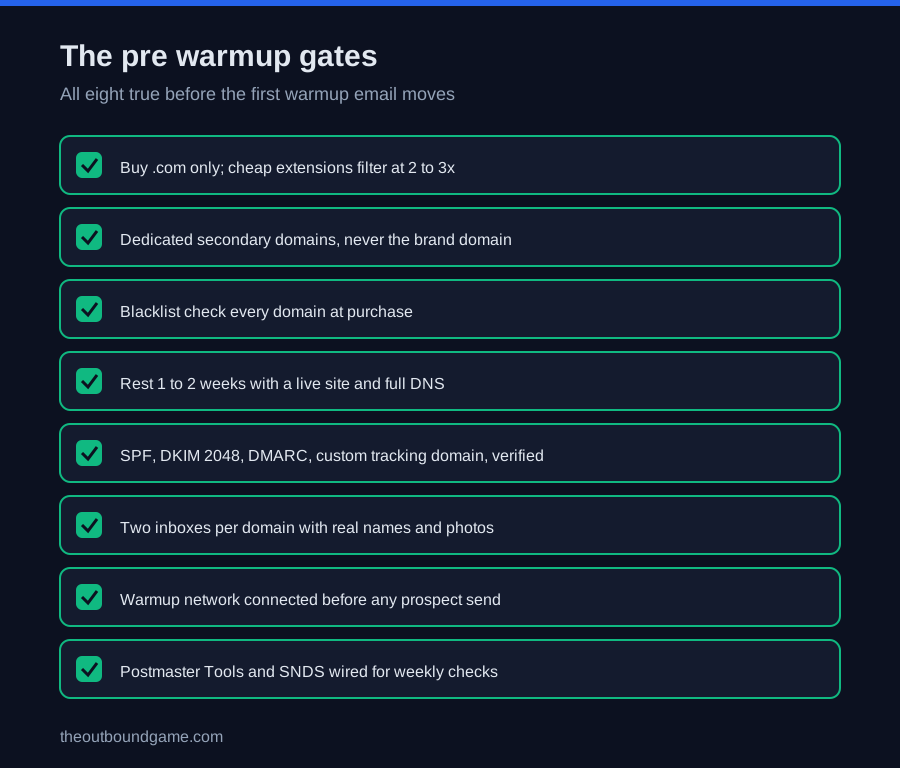
Warmup starts with purchases, not sends. Buy .com domains only, because cheap extensions like .xyz and .info get filtered at 2 to 3 times the rate before any behavior is measured, and buy them as dedicated secondary domains, never your primary brand domain, so a reputation problem stays quarantined away from your product and billing email. Check every purchased domain against blacklists before investing a single day, since resellers move previously burned domains, and warming a pre flagged asset wastes weeks. Then let the domain rest: 1 to 2 weeks minimum with a live website, real DNS records, and zero outbound mail, because registering on Monday and sending on Tuesday is itself a spam signal.
During the rest period, build the authentication layer: SPF, DKIM at 2048 bits, DMARC, and a custom tracking domain, verified with a DNS checker rather than trusted from the platform’s defaults, because missing any one of the four causes 10 to 20 percent automatic spam filtering even on an otherwise perfectly warmed domain. Create 2 inboxes per domain, real names, real profile photos, real signatures. The full capacity math, how many domains and inboxes a given daily volume needs, lives in the sending limits guide; the warmup rule is simply that every new inbox walks the same ramp.
The 30 day warmup schedule, gated on signals
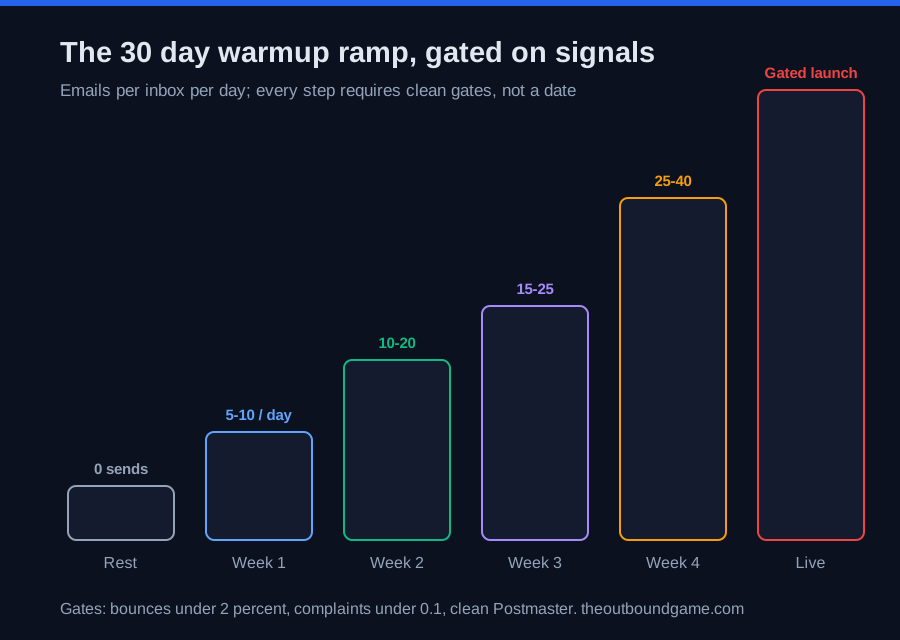
Week one runs 5 to 10 emails a day per inbox, all warmup traffic, no prospects, plain text, no tracking pixels, sent during business hours in your time zone. The job of week one is behaving like a human: messages that get opened, replied to, starred, and rescued from spam, which is exactly what modern warmup tools automate through networks of real inboxes exchanging genuinely engaged mail. Week two ramps to 10 to 20 a day, week three to 15 to 25, week four to 25 to 40, increasing by roughly 3 to 5 emails a day with slightly randomized steps, because perfectly linear growth is its own machine signature.
The gates matter more than the dates. Volume only steps up when the current level holds: bounces under 2 percent, with 3 percent a warning and 5 a full stop; spam complaints under 0.1 percent with 0.08 the graduation standard; warmup engagement rates holding steady; and Google Postmaster Tools plus Microsoft SNDS showing neutral to good reputation, checked weekly alongside a blacklist scan. If any gate fails, volume freezes or halves until it clears, and a domain that needs five weeks to pass the gates takes five weeks. Around day 30, run a placement test to seed inboxes across Gmail, Outlook, and Yahoo: majority primary inbox placement plus clean Postmaster reputation is the graduation certificate, and first campaigns then launch at 10 to 15 cold sends per inbox per day, per the ramp rules in the volume guide.
Maintenance mode: warmup never fully stops
Graduation does not end the process, it changes its ratio. Sender reputation decays without positive signals, so the standing practice is keeping warmup running indefinitely at 5 to 10 messages a day per inbox, roughly a fifth of send volume, alongside live campaigns, and the rule that trips most teams: those warmup messages count inside each inbox’s daily ceiling. An inbox capped at 40 total daily sends running 10 warmup messages has 30 cold slots, and stacking campaign volume on top of warmup volume is how teams breach their limit while believing they are under it.
Maintenance also means the real campaigns must hold up their end, because warmup adds positive signals but cannot outweigh bad sending behavior. A verified list holding bounces under 2 percent, per the disciplines in how to build a b2b prospect list, copy that earns replies, since replies are the strongest positive signal a domain can receive and the reply rate levers are therefore deliverability levers too, and sequence behavior inside the complaint thresholds. When placement slips despite healthy warmup, the diagnosis moves to the ranked causes in why cold emails go to spam, and more warmup volume is explicitly not the fix.
Five warmup mistakes that burn the asset
-
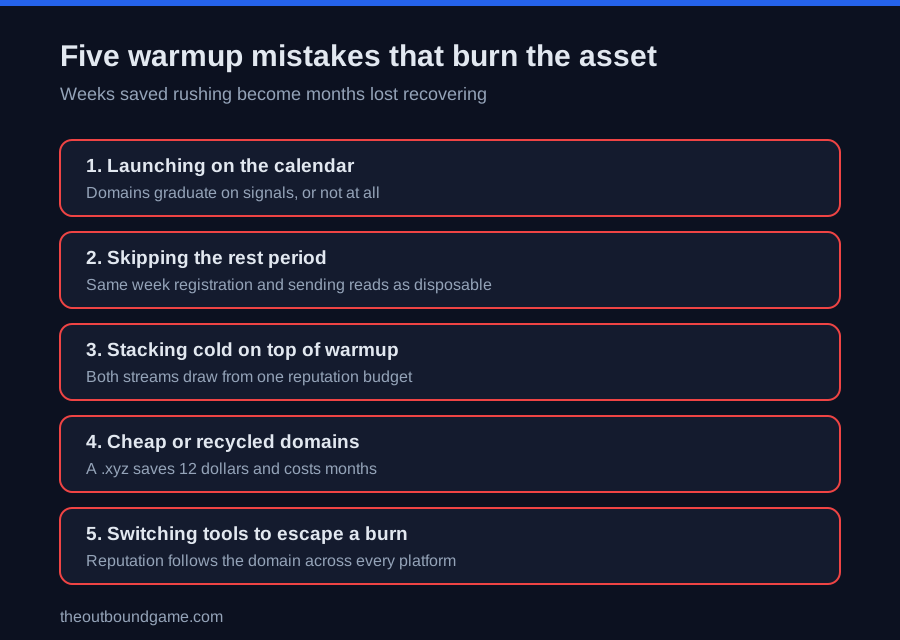
Launching on the calendar instead of the gates. A booked campaign date is not a deliverability signal. Domains graduate on bounce, complaint, and placement numbers, or not at all.
-
Skipping the rest period. A domain that sends mail the week it was registered announces itself as disposable infrastructure. Two quiet weeks with a website first.
-
Stacking cold volume on top of warmup volume. Both streams draw from one reputation budget. Count the warmup messages inside the cap or breach it invisibly.
-
Warming on cheap extensions or recycled domains. A .xyz saves 12 dollars and costs months, and an unchecked reseller domain may arrive pre blacklisted.
-
Switching tools to escape a burned reputation. Domain reputation persists across ESPs, IPs, and platforms. A domain burned on one sequencer arrives burned at the next one.
The eight step warmup operating procedure
-
Buy .com secondary domains in threes, blacklist checked at purchase, so a warming spare always exists behind every producing domain.
-
Rest each domain 1 to 2 weeks with a live site and full DNS before any mail moves.
-
Authenticate everything before warmup begins. SPF, DKIM, DMARC, custom tracking domain, verified externally, on every domain without exception.
-
Run the four week ramp: 5 to 10, then 10 to 20, then 15 to 25, then 25 to 40 a day per inbox, in randomized steps, business hours, plain text.
-
Check the gates weekly. Postmaster and SNDS reputation, bounces, complaints, blacklists, and freeze the ramp on any breach.
-
Graduate on evidence. A day 30 placement test majority landing in the primary inbox, then first campaigns at a third of capacity through your cold email software, whose built in warmup networks, compared in instantly vs smartlead, handle the engagement mechanics.
-
Shift to maintenance. Warmup at a fifth of volume forever, counted inside the ceilings, with reply earning campaigns doing the rest.
-
Retire honestly. A blacklisted domain is effectively unrecoverable for cold outreach, delisting takes weeks and often fails, so a flagged domain gets replaced by the warmed spare, and prevention remains the only strategy that pencils, the same discipline the whole b2b outbound sales system runs on.
How warmup fits the broader outbound stack
-
It is the reputation foundation under the volume ceilings in how many cold emails per day, where the graduated limits live.
-
Its failure modes are ranked in why cold emails go to spam, where warmup skipping sits near the top.
-
Its payoff shows up in the cold email benchmarks tiers, where placement decides which tier is even reachable.
-
Its strongest ongoing signal, real replies, is manufactured through the levers in cold email reply rate.
-
Its list side dependency, bounces under 2 percent, is built in how to build a b2b prospect list.
-
Its automation layer lives in cold email software and the warmup network comparison in instantly vs smartlead.
-
Its place in the launch sequence, week three of the roadmap, is scheduled in how to start outbound sales.
-
And the messages it exists to deliver are written in cold email, where the craft finally gets its chance to matter.
FAQ
Frequently asked questions
How do you warm up an email domain?
How long does it take to warm up an email domain?
Can you skip warmup for a new domain?
What is a good warmup schedule?
Should warmup keep running after campaigns launch?
How do you fix a burned email domain?
Do warmup tools actually work?
The bottom line
How to warm up an email domain reduces to a credit building loop run with patience: the right asset, a .com secondary, rested and authenticated, a four week ramp in small randomized steps, gates checked before every increase, graduation earned by a placement test, and then maintenance forever at a fifth of volume inside the ceilings. The calendar is the input and the signals are the output, thirty days is the floor rather than the finish line, and the whole discipline exists because the alternative math never works: the weeks saved by rushing become months lost to recovery, and the domain that spent a month earning trust outsends the rushed one for the following year. Pay the warmup cost up front. It is the cheapest insurance in outbound.
Want more tested breakdowns like this? We publish one honest teardown of outbound tools, tactics, and playbooks each week. Join the newsletter.
More on Deliverability
Best Email Warmup Tools in 2026 (Tested and Ranked)
The best email warmup tools in 2026 ranked by pricing model, warmup network quality, and team shape, from dedicated tools to sequencer bundled warmup.
How Many Cold Emails Per Day? Safe Limits for 2026
How many cold emails per day is safe in 2026: the per inbox limits, warmup ramp, why the cap includes warmup sends, and the math for scaling volume.
Why Cold Emails Go to Spam in 2026 (and How to Fix It)
Why cold emails go to spam in 2026: the seven causes ranked by how often they are guilty, the thresholds Google enforces, and the fix for each one.