Do AI SDRs Actually Work in 2026? The Honest Numbers
Do AI SDRs actually work in 2026? The honest numbers: churn rates, reply benchmarks, where agents deliver real pipeline, and where they burn budget.
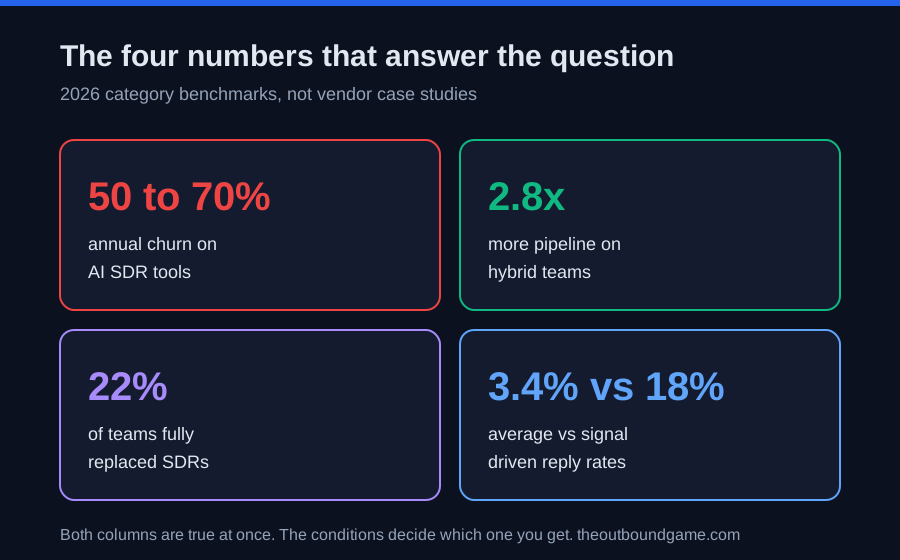
Do ai sdrs actually work? It is the most searched question in the category, and both stock answers are wrong. The vendor answer, that an ai sdr books meetings while you sleep, cannot explain why 50 to 70 percent of buyers do not renew within a year. The cynic answer, that the whole category is hype, cannot explain why teams pairing agents with human reps report 2.8 times more pipeline, or why roughly 22 percent of teams have already replaced their sales development function with software entirely and kept it that way.
Hold both numbers at once and the honest answer appears: yes, ai sales agents work, conditionally, and the conditions are knowable in advance. The same product succeeds in one company and churns in the next, which tells you the variable is not the tool. It is what the tool was given: the message, the data, the sending infrastructure, and the metric it was graded on. This article lays out the evidence on both sides, the conditions that separate the outcomes, and how to test the question on your own pipeline in 90 days instead of arguing about it.
It slots into our AI cluster beside the ai sdr explainer, the best ai sdr tools ranking, and the ai sdr vs human sdr cost breakdown, and it assumes the foundations from the b2b outbound sales pillar. If you run b2b prospecting and need a straight answer before signing an agent contract, this is it.
The evidence that they work
Start with what the successful deployments have in common. In documented wins, agents carry the volume work a human team cannot sustain: hundreds of researched accounts per day, first touches sent in the prospect’s timezone, and follow up sequences that never skip a step. Since follow up discipline is where most human pipelines quietly leak, that alone produces measurable lift. The hybrid configuration, agents on sourcing, research, drafting, and chasing, humans on replies, phones, and judgment, is the setup behind the 2.8 times pipeline figure, and it recurs across every credible 2026 dataset rather than living in one vendor’s case study.
Full replacement also genuinely works in a specific shape of company: large, fairly uniform TAM, an email first motion, a message already proven by humans, and economics where volume decides outcomes. That is the 22 percent. The point is that ai sdr results are real, reproducible, and concentrated in deployments that met the conditions before the contract was signed.
The evidence that they fail
Now the other side of the ledger, because it is just as real. Annual churn on agent tools runs 50 to 70 percent, an extraordinary number for B2B software, and it clusters in three patterns. First, automating an unproven message: the agent sends rejection bait at machine speed, replies never come, and the tool is blamed for a pitch that was never tested. Second, starving the inputs: thin or stale contact data makes personalization hallucinate, and skipped deliverability work sends good emails to spam, which is why the deeper failure analysis consistently points at the stack underneath rather than the model on top. Third, grading on vanity: agents inflate meetings booked effortlessly, and teams that never measured meetings held discover a quarter later that the pipeline is hollow.
Reply rates make the same argument from benchmark data. Average cold outreach earns about 3.4 percent replies in 2026, while signal driven, deeply personalized campaigns reach 18 percent. That five times spread exists on both sides of the human and machine line. The sender was never the variable. The signal and the message were.
The conditions that decide the answer
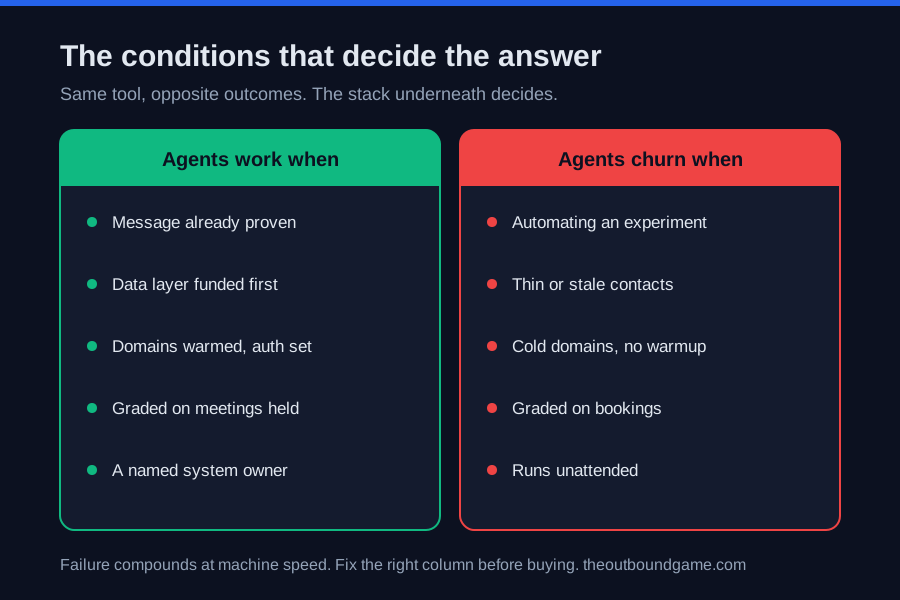
Ask do ai sdrs actually work in this frame and the conditions answer it. Agents work when the message is proven, meaning humans or a copilot tier already validated that the offer earns replies on a small list. They work when the data layer is funded, because personalization is only as good as the verified contacts and live signals feeding it, which is why serious budgets put roughly 40 percent into data before intelligence. They work when sending infrastructure is treated as a first class asset: dedicated domains, correct authentication, warmed mailboxes, safe volumes. And they work when the grading metric was agreed in advance, cost per meeting held and opportunities created, not activity.
Agents fail when any one of those four is missing, and the failure compounds because machines scale whatever they are given. An unproven pitch fails a hundred times faster. Thin data hallucinates at volume. A cold domain burns in days instead of weeks. This is also why the question in our ai sdr vs human sdr breakdown resolves to division of labor rather than replacement for most teams: the human in the loop is the cheapest insurance against compounding.
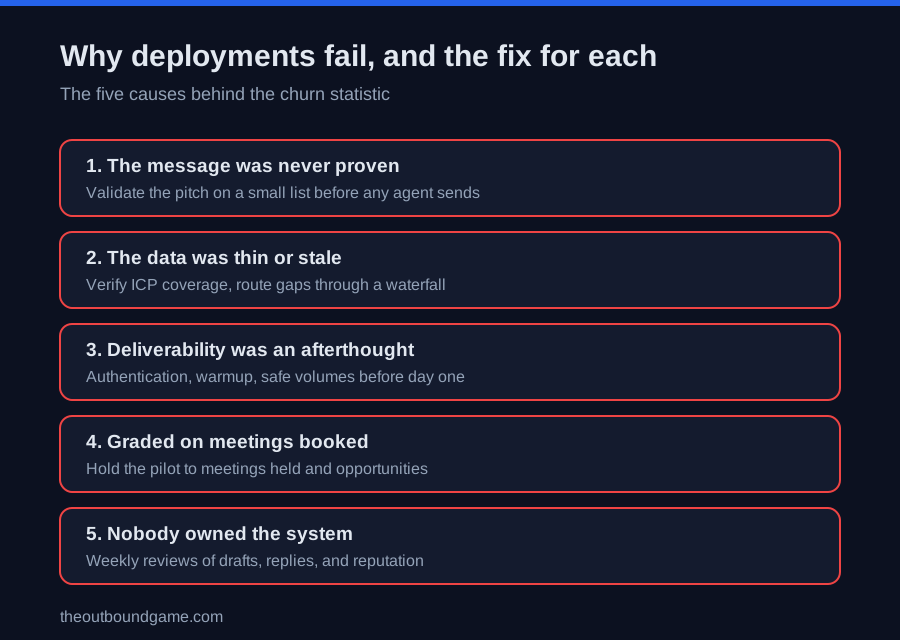
Five reasons AI SDR deployments fail, and the fix for each
-
The message was never proven. The agent automated an experiment. Fix: validate the pitch manually or on a copilot tier until replies confirm it, then hand it over.
-
The data was thin or stale. Personalization hallucinated and prospects noticed. Fix: verify coverage of your ICP before connecting anything, and route gaps through an enrichment waterfall.
-
Deliverability was an afterthought. Good emails landed in spam and the agent took the blame. Fix: authentication, warmup, and safe volumes before the first send, per the deliverability fundamentals.
-
The metric was meetings booked. The dashboard glowed while pipeline hollowed. Fix: grade on meetings held and opportunities created, agreed with finance before the pilot starts.
-
Nobody owned the system. The agent ran unattended, drift went unnoticed for weeks. Fix: assign an owner who reviews drafts, replies, and sender reputation weekly, exactly as you would manage a new rep.
An eight step 90 day test that settles it for your team
-
Write the hypothesis. Which segment, which message, what cost per held meeting would beat your current motion. One page, agreed with finance.
-
Verify the message first. If replies have not already validated the pitch, run two weeks of manual or copilot sends before any agent touches it.
-
Fund the inputs. Verified data on the pilot segment, dedicated sending domains, authentication, warmup. The agent is the smallest line item in a serious pilot.
-
Fence the pilot. One segment, 60 to 90 days, agent autonomy limited to sourcing, drafting, and follow up in week one, widening only as drafts prove clean.
-
Route warm replies to a human from day one. Interest is too expensive to leave to a model, and the handoff is where hybrid teams earn their 2.8 times.
-
Review weekly. Drafts, bounces, spam placement, reply sentiment. Drift caught in week two costs nothing; drift caught in month three costs the quarter.
-
Grade on the agreed numbers. Cost per meeting held and opportunities created against your human baseline, with churn signals from G2 reviews as a sanity check on the vendor itself.
-
Decide like an operator. Beat the baseline: scale the segment. Miss it: kill the contract, keep the data and infrastructure, both outlive any tool choice.
How the answer fits the broader outbound stack
-
Agents inherit the whole b2b outbound sales system, so the answer starts with whether that system works.
-
Their knowledge is bought in the data layer, which makes the b2b data providers decision a bigger driver of ai sdr results than the agent brand.
-
Coverage gaps close through data enrichment tools, the waterfall that keeps personalization grounded in verified facts.
-
The signals behind the five times reply spread live in sales intelligence tools, and they lift any sender.
-
Sending mechanics remain a sales engagement platforms concern, whichever intelligence sits on top.
-
Agent and human handoffs survive only when CRM automation keeps ownership, history, and dedupe clean.
-
The budget verdict follows sales automation ROI discipline: loaded costs, incremental results, payback measured in months.
-
And the pitch the agent scales is still written at the cold email layer, where a proven message outperforms a clever model every time.
FAQ
Frequently asked questions
Do AI SDRs actually work?
Why do so many AI SDR deployments fail?
What reply rates do AI SDRs get?
When does an AI SDR genuinely replace a human?
How long should an AI SDR pilot run?
How much do AI SDR tools really cost?
What should I measure to know if it is working?
The bottom line
So, do ai sdrs actually work in 2026? Yes, when the motion underneath them already works: proven message, funded data, disciplined sending, honest metrics, and an owner. No, when autonomy is bought to escape those fundamentals, which is exactly what the churn statistic is measuring. The tool was never the variable. Run the 90 day test on a fenced segment, grade it on meetings held, and let your own baseline, not a demo or a hot take, give you the answer.
Want more tested breakdowns like this? We publish one honest teardown of outbound tools, tactics, and playbooks each week. Join the newsletter.
More on AI Sales Tools
AI SDR vs Human SDR in 2026: The Real Cost and Results
AI SDR vs human SDR in 2026: the loaded cost math, real pipeline numbers, where agents win, where reps win, and the hybrid model that beats both.
The Best AI SDR Tools in 2026: An Operator Field Guide
The best AI SDR tools in 2026, ranked honestly: real pricing from 250 to 5,000 dollars a month, what the agents actually do, and who should skip them.
AI Cold Email in 2026: A Full Operator Field Guide
AI cold email in 2026 for B2B teams: where AI genuinely lifts reply rates, the signal-based shift, the spam-filter trap, and what truly works.