AI SDR: What It Is and Whether It Actually Works in 2026
An AI SDR automates prospecting, outreach, and follow-up. An operator guide to what AI SDR tools do, what they cost, and where they fail in 2026.
An AI SDR is software that automates the work a human sales development representative does: finding prospects, researching accounts, writing outreach, running follow-up sequences, and booking meetings. The category exploded in 2024 and 2025 on a simple promise, replace your SDR team with an autonomous agent that works around the clock at a fraction of the cost. In 2026 the data on that promise is in, and the honest answer is more interesting than either the hype or the backlash suggests.
Here is the number that matters. A fully loaded human SDR costs 75,000 to 110,000 dollars a year once you add salary, benefits, tools, and management overhead, and takes three to six months to ramp. An AI SDR promises the same top-of-funnel output for a published range of about 500 to 5,000 dollars a month. On paper the economics are overwhelming. In practice, what you actually get for that money varies so wildly that two products both calling themselves an AI SDR can be entirely different things, one a genuine autonomous SDR, the other a sequencer with an AI label.
This is the pillar guide to the whole category. We will define what an AI SDR actually is, break down how the technology works, lay out current pricing without the sales-call runaround, and cover the part most articles on this topic miss: where these tools fail and why the autonomous narrative quietly collapsed in 2026. Where a topic deserves its own deep dive, like the best AI SDR tools head to head or the broader best AI sales tools landscape, we link out to it.
What an AI sales agent actually is
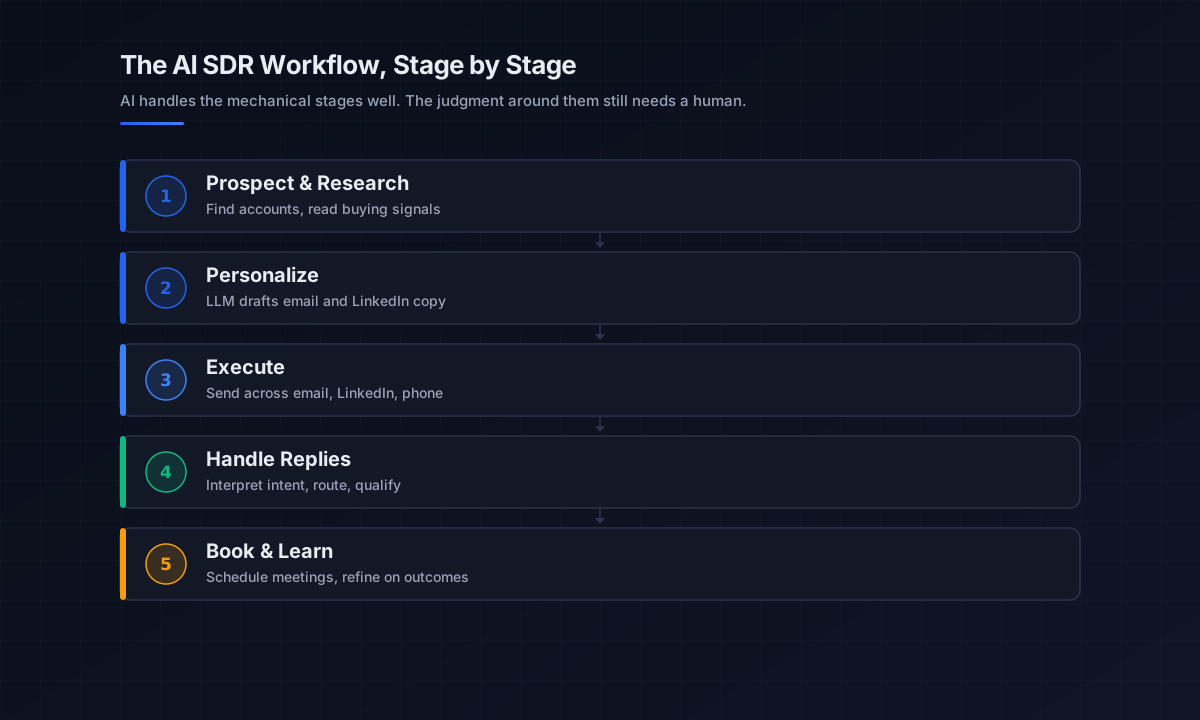
An AI SDR, sometimes called an AI sales agent, AI BDR, or virtual SDR, is an AI-powered system that replicates the top-of-funnel activities of a human sales development rep. Those activities are consistent across every serious platform: identifying and researching prospects, generating personalized outreach across email and LinkedIn, managing multi-touch sequences, handling replies and objections, qualifying leads, and booking meetings into a calendar.
The critical distinction, and the one that determines whether you will be happy with what you buy, is autonomy level. There are two genuinely different products hiding under one label.
Autonomous agents versus copilots
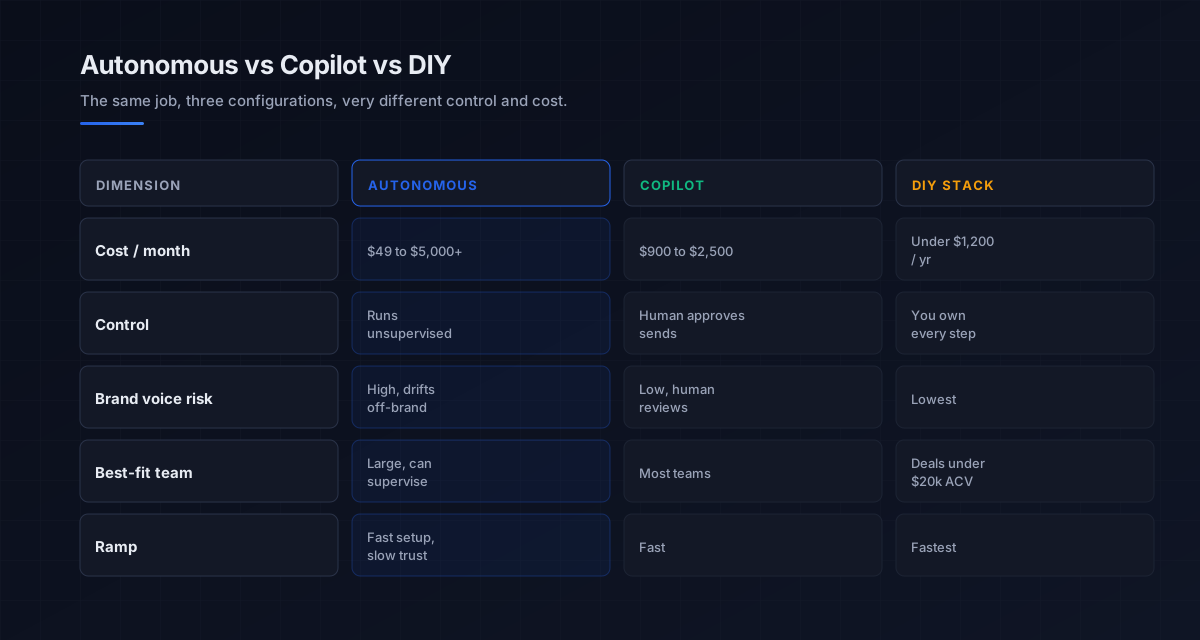
A fully autonomous agent operates independently. You configure your ideal customer profile, connect your data and sending infrastructure, and the agent prospects, writes, sends, and follows up without a human approving each step. 11x (its agent is called Alice), Artisan (Ava), and AiSDR sit at this end.
An AI-augmented copilot does the time-intensive research and drafting, then hands control to a human who decides what actually gets sent. Amplemarket’s Duo and Regie.ai, which layers AI content generation on top of sales engagement platforms like Outreach and Salesloft, sit here. The copilot model keeps a human in the loop on judgment, timing, and brand voice, the three things the data shows AI handles worst.
Where the line blurs
Many tools market themselves as an autonomous SDR when they are closer to an advanced sequencer. The pattern we see is that the word “autonomous” gets stretched to mean “sends without you clicking send,” which is automation, not agency. A genuine autonomous SDR makes decisions about who to contact and what to say based on signals; a glorified sequencer just executes a rule you set. When you evaluate, the test is simple: does it decide, or does it just do what you told it.
How an AI sales agent works under the hood
Understanding the mechanics helps you ask better questions and set realistic expectations. Every AI sales agent runs on four layers.
The data layer
The agent needs contacts to work. Some platforms include a built-in database (Artisan claims 300M+ contacts, AiSDR 700M+), while others, including 11x, require you to bring or separately pay for data. This matters more than the AI itself. Feed clean, verified, role-correct data in and the output is good; feed stale data in and you burn sender reputation on bounces no matter how clever the model is. Data quality is the single biggest predictor of whether the agent works, which is why the data and enrichment layer deserves as much attention as the agent.
The intelligence layer
Modern AI SDRs are built on or integrated with large language models, fine-tuned on sales conversations. This layer reads buying signals, job changes, funding news, technology changes, and decides who to prioritize and what angle to use. It also interprets replies, distinguishing genuine interest from a brush-off, and routes accordingly. This is the part that separates a real AI sales agent from a sequencer.
The execution layer
This sends across channels: email, LinkedIn, and increasingly phone. Emerging platforms now add voice AI that can place calls and handle preliminary qualification. The execution layer is also where deliverability lives, and most AI SDRs do not include sending domains or inboxes, so budget 15 to 50 dollars a month for dedicated domains and warmup on top of the headline price. For the technical side of getting those messages seen, email deliverability and sender reputation are covered in depth on our sister publication.
The learning layer
The better tools improve over time, refining their understanding of your ICP based on which leads actually convert and which messaging lands. This is real, but it is slower and less dramatic than vendor demos suggest, and it depends entirely on having enough volume and clean feedback data to learn from.
What AI SDR tools cost in 2026
AI SDR pricing in this category is deliberately opaque. Several leading vendors hide their numbers behind a sales call, which is itself a signal: if you have to sit through a demo to learn the price, you are being qualified as a buyer, not informed as one. Here is what the platforms actually cost, drawn from published rates and procurement data.
At the budget end, Apollo starts around 49 dollars per user per month for database plus sequences, and Reply.io’s Jason AI starts at about 500 dollars a month. In the mid-market, AiSDR publishes two tiers, 900 dollars a month for Explore and 2,500 for Grow, on quarterly commitments, and Amplemarket’s Growth tier runs roughly 2,000 to 5,000 a month. At the enterprise end, 11x runs a commonly cited package around 5,000 dollars a month (procurement data puts the median annual contract near 40,000 dollars), and Artisan lands around 2,200 a month at the median with a range that procurement data shows spanning 9,000 to 57,000 dollars a year. That spread tells you negotiation matters more than any list price.
Then there are the costs that are not in the headline number: separate data subscriptions, email infrastructure, credit overages on usage-based plans, annual contract penalties, and enterprise onboarding fees that can reach five figures. Ask about every one before signing. The autonomous tools at the top of the market frequently require annual commitments, and multiple reviewers describe difficult cancellation processes, so the stakes of a bad fit are real.
Where AI SDRs fail, and why the autonomous narrative collapsed
This is the section the vendor blogs will not write. The fully autonomous AI SDR narrative peaked in 2024 and 2025. By early 2026 the results were clear: autonomous AI SDRs have not replaced human sales teams at any meaningful scale. The most heavily funded entrant in the category, which raised 74 million dollars from top-tier investors, could not retain its own customers. Companies that deployed the leading autonomous tools as full SDR replacements have largely reverted to hybrid models or returned to human-first approaches.
The reason is structural, not a temporary limitation that the next model release fixes. Sales development is not just email generation at scale. It is judgment, timing, relationship awareness, brand stewardship, and contextual decision-making. AI handles the mechanical parts brilliantly and the judgment parts poorly. There is a trade-off the autonomous vendors do not advertise: the more you let the agent run unsupervised, the more generic and off-brand its output drifts, because it optimizes for activity, not for whether a given message should exist.
What this means in practice is that the winning configuration in 2026 is hybrid. The AI does the research, drafting, and sequencing; a human owns the ICP definition, the positioning, the edge cases, and the high-value conversations. That is not a failure of the technology. It is the correct division of labor, and it is what the best AI sales tools are increasingly built around.
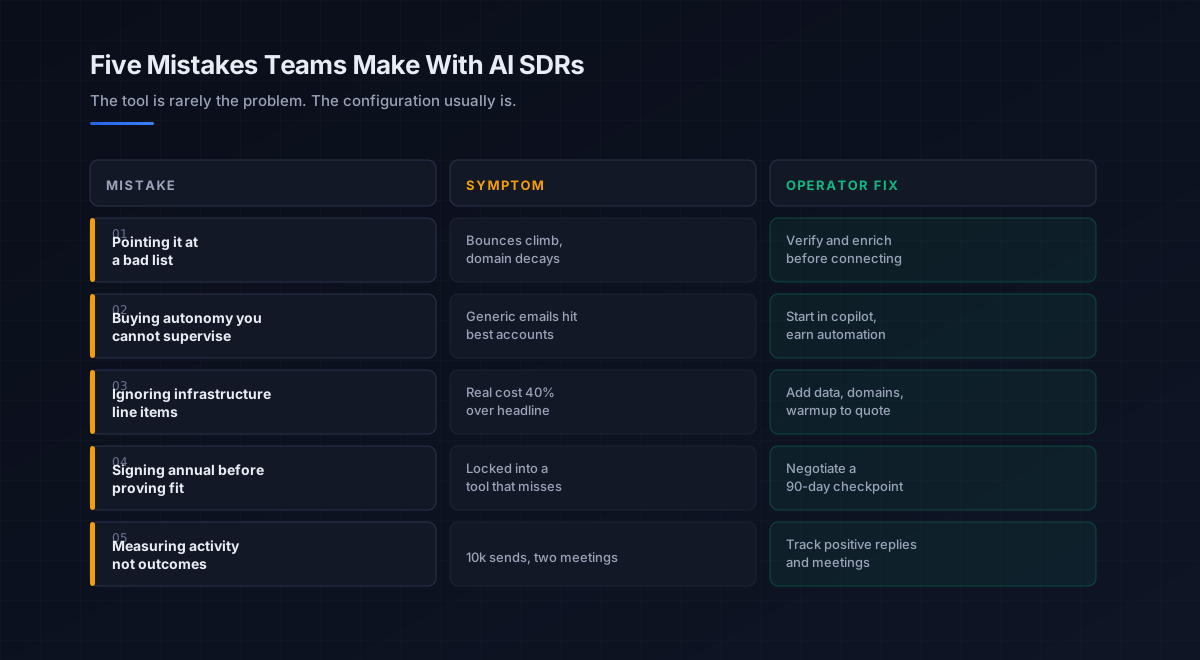
Five mistakes teams make with AI sales agents
What we see most often is not one fatal error but a handful of avoidable ones that turn a promising tool into a reputation problem.
-
Pointing it at a bad list. The agent amplifies whatever data you feed it. A 15 percent bounce rate on a stale list does not get better with AI; it scales the damage faster. Verify and enrich before you connect anything.
-
Buying autonomy you cannot supervise. Fully autonomous mode on a small team with no review process means generic emails reaching your best accounts unsupervised. Start in copilot mode and earn the right to automate.
-
Ignoring the infrastructure line items. The headline price rarely includes sending domains, warmup, or data. Teams sign at 2,500 a month and discover the real cost is 3,500 once infrastructure is added.
-
Signing annual before proving fit. The opaque-pricing tools push annual commitments hard, and cancellation is often difficult. Negotiate a 90-day performance checkpoint before locking in a year.
-
Measuring activity instead of outcomes. A tool that sends 10,000 emails and books two meetings is worse than a human who sends 400 and books eight. Report on positive replies and meetings booked, not volume.
How to evaluate an AI sales agent: an eight-step framework
This is the order we work through when the teams we work with are choosing a tool. Run it top to bottom before you book a single demo.
- Define the job first. Decide whether you want a tool to replace SDR capacity or augment existing reps. The answer rules out half the market immediately.
- Audit your data. If your contact data is not clean and verified, fix that before evaluating any agent. The data layer determines the ceiling.
- Decide your autonomy tolerance. Be honest about whether you can supervise an autonomous agent. If not, shortlist copilots.
- Get real pricing. Refuse to evaluate a tool that will not give you a number. There are enough transparent options that opacity is a reason to walk.
- Map the hidden costs. Add data, infrastructure, onboarding, and overage to every quote so you compare true total cost.
- Test on a real segment. Run a 90-day pilot on one tight segment, not a broad blast, and judge on positive replies and meetings.
- Check the exit. Read the cancellation terms before signing. Annual lock-in with a hard exit is a real risk in this category.
- Keep a human on judgment. Whatever you choose, design the workflow so a person owns ICP, positioning, and the edge cases.
How AI sales agents fit the broader outbound stack
An AI SDR is one layer inside a larger system, and it only works when the layers around it are solid. Each connects to a deeper guide.
- Strategy and targeting. The ICP and positioning the AI executes against, covered in outbound sales.
- Data and enrichment. Clean, verified contacts, the ceiling on AI output, in data enrichment tools.
- The agents themselves. The head-to-head in best AI SDR tools and the wider best AI sales tools landscape.
- Automation tooling. Adjacent automation in best AI sales automation tools.
- Prospecting AI. Research-stage tools in best AI tools for sales prospecting.
- Sending infrastructure. Deliverability and warmup, covered on email deliverability.
- Engagement platforms. Where copilots like Regie plug in, in sales engagement platforms.
- The phone channel. Voice AI overlaps with AI cold calling as agents add voice.
That is the map. The AI SDR generates and sends, clean data sets the ceiling, infrastructure gets the messages seen, and a human owns the judgment that decides whether the whole motion is pointed at the right accounts.
Frequently asked questions
What is an AI SDR?
Do AI SDRs actually work?
How much does an AI SDR cost in 2026?
What is the difference between an AI SDR and an AI sales agent?
Can an AI SDR replace a human SDR?
What should I check before buying an AI SDR?
Are autonomous AI SDRs better than copilots?
The bottom line
The category is real and useful, but not in the way it was sold. The autonomous dream of firing your SDR team and letting an agent run pipeline unsupervised did not survive contact with reality in 2026. What did survive is the hybrid model: AI as a research, drafting, and sequencing engine that scales the mechanical work, with a human owning the ICP, the positioning, and the judgment about whether a message should exist at all.
If you take one thing from this guide, make it this. Buy these tools to amplify good judgment and clean data, never to substitute for them. Evaluate on outcomes, insist on transparent pricing, fix your data before you connect anything, and keep a human on the decisions that matter. Do that and the economics genuinely work. Skip it and you are paying a premium to scale your worst outreach faster.
Get the operator playbook in your inbox. The Outbound Game publishes one operator-grade breakdown a week on AI in outbound, sales tech, and the tactics that actually book meetings. No vendor talking points. Subscribe and get the next one when it ships.