Cold Email Subject Lines That Get Opened in 2026, Tested
Cold email subject lines that get opened in 2026, with the data behind each. An operator guide to length, personalization, and why open rate lies.
Cold email subject lines decide whether half your pipeline ever gets read, and yet most advice about them optimizes for a metric that broke in 2021. Around 47 percent of recipients decide whether to open based on the subject line alone, and in B2B outreach the subject drives 50 to 70 percent of whether your email gets read at all. That part is real and durable. What is not durable is the open-rate scoreboard everyone uses to judge subject lines, because Apple Mail Privacy Protection now pre-loads tracking pixels on roughly 50 to 60 percent of opens, inflating the number into fiction. You can win the open-rate A/B test and move zero extra pipeline.
That is the uncomfortable truth this guide is built on. A variant that hits 48 percent opens against another at 31 percent can generate the exact same number of positive replies, which means the metric you are optimizing is lying to you. The best cold email subject lines in 2026 are short, signal-driven, and continuous with the first line, and you judge them by positive reply rate, not opens. The tactics from 2019, numbers, urgency words, title case, have decayed or reversed, so this is built on current data, not recycled playbooks.
This is the open-rate layer of the cold email pillar, and it pairs with the cold email templates guide, since the subject line and opener must feel like one continuous thought. None of it matters, though, if the email never reaches the inbox, so the email deliverability foundation comes first: roughly 17 percent of cold emails never arrive at all, and a bad subject line cannot lose a race the email never entered.
Why most subject line advice is wrong now
Before tactics, understand what changed, because most of what ranks on this topic is benchmarked against 2019 data. Two shifts broke the old playbook.
Open rate is a broken metric
Apple Mail Privacy Protection pre-loads images, including your tracking pixel, on a majority of opens, so reported open rate is heavily inflated and no longer maps to attention. A subject line that lifts opens but not replies has done nothing. This is why the only reliable scoreboard for cold email subject lines in 2026 is positive reply rate, the share of sends that produce genuine interest. Optimize that, treat open rate as a rough directional signal at best, and you stop chasing a number Apple already broke.
Tactics decayed
The specific tricks reversed. A 2021 study found numbers in subject lines boosted opens 45 percent; a 5.5-million-email 2024 dataset found numbers slightly hurt, 27 percent opens versus 28 percent without. “Quick question” and generic first-name greetings now feel played out and underperform as everyone uses them. The lesson is not a new list of tricks, it is that tactics decay and principles last. Short, relevant, and specific endures; whatever clever format is trending does not.
The anatomy of a subject line that gets opened
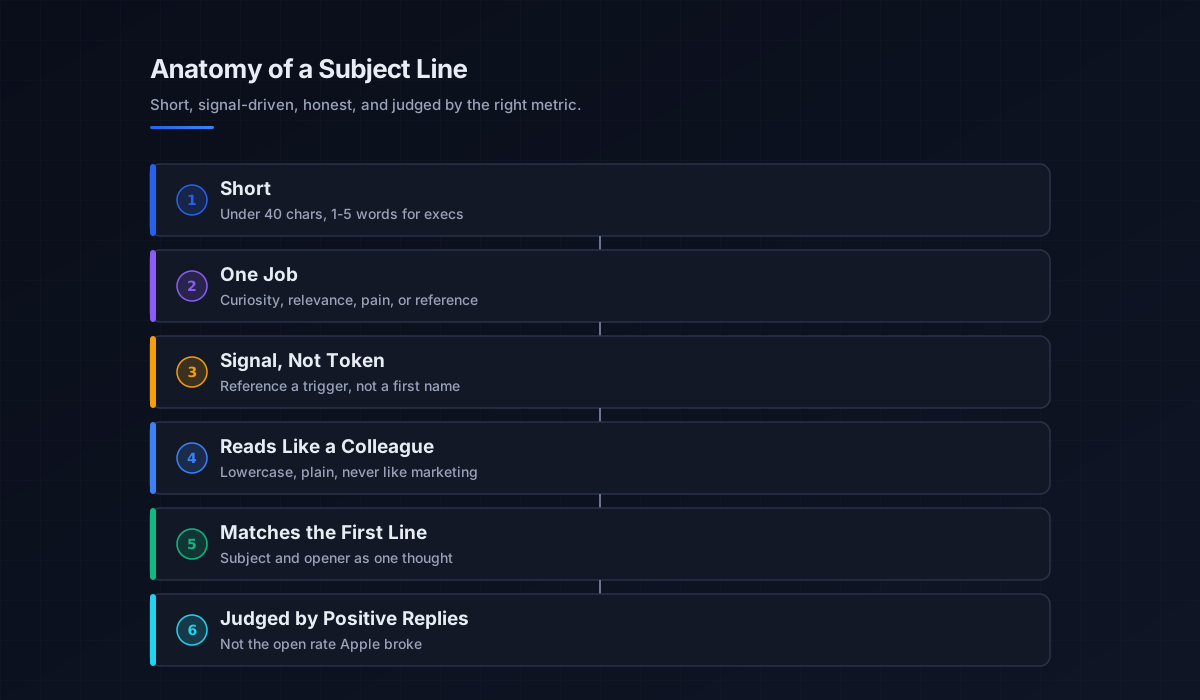
A high-performing cold email subject line does at least one job well and follows a few durable rules. The principles below hold across every recent dataset.
Keep it short
Short wins, and the shorter the more senior the prospect. Aim for 33 to 40 characters or fewer so it displays fully on mobile, where most email is first seen, and for executive prospects go shorter still, 1 to 5 words, under 30 characters. Backlinko’s analysis across billions of emails confirms this range delivers the highest engagement in B2B. Long, clever subject lines get truncated and ignored.
Make it do one job
Every subject line that works creates curiosity, signals relevance, names a specific pain, or references something real. It does not try to do all four. Questions tend to outperform statements because they open a curiosity gap, and the best email subject lines read like a message from a colleague, lowercase, plain, and specific, not like marketing. Anything that reads like a campaign gets filtered by humans and spam engines alike.
Personalize with a signal, not a token
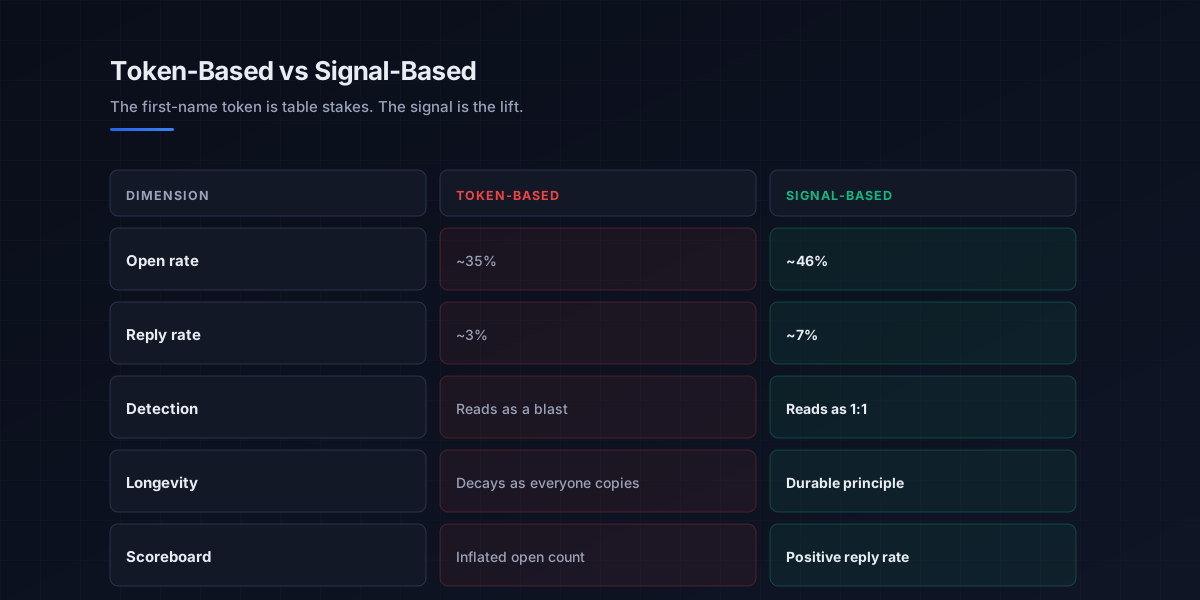
This is where the real lift lives, and where most teams get it wrong. The data is consistent: personalized subject lines hit roughly 46 percent opens against 35 percent without, and reply rates more than double, 7 percent versus 3 percent. But basic first-name tokens alone no longer move the needle, they are table stakes, not a differentiator. The subject line personalization that works references a company initiative, a recent hire, a funding round, or a technology they use. Trigger-event subjects reach the highest open rates of any category. The signal is the lift, not the merge field.
Match the first line
The subject and the opener must feel like one continuous thought. If the subject says “saw your APAC expansion” and the email opens on a generic pitch, the disconnect kills trust instantly and the reply never comes. This continuity is why subject lines cannot be written in isolation from the cold email templates they sit on top of.
Subject line formats that work in 2026
These are durable formats, not scripts. Fill them with a real signal, keep them short, and pair each with a matching opener. Treat the bracketed parts as research to do, not tokens to merge.
The trigger reference: “saw your [funding round / new office / key hire]”. The highest-performing category, because the trigger proves relevance and timeliness in a few words.
The specific observation: “quick thought on your [specific process or page]”. Works when there is no public trigger but you noticed something real about their site, hiring, or stack.
The named pain: “[their role]s and [specific problem]”. Speaks to something the recipient already thinks about, which earns the open without a gimmick.
The soft question: “worth a look at [specific outcome]?”. A low-pressure curiosity gap that reads like a colleague, not a pitch.
The mutual context: “fellow [shared background] at [company]”. Shared experience or connection is a strong trust signal that lifts opens honestly.
Notice what is absent: no all caps, no “free” or “guaranteed,” no excessive punctuation or emoji for B2B executive audiences, all of which trigger spam filtering, and roughly 69 to 70 percent of people will mark an email as spam from the subject line alone. The best b2b subject lines look nothing like marketing.
How to test subject lines without fooling yourself
Testing is where the broken-metric problem bites hardest, so the method matters. Test four to five variants at once, enough to learn without splitting volume too thin, and change one element at a time so you know what moved the result. Crucially, judge on positive reply rate, not open rate, because a high-open, low-reply result usually means the subject works but the body does not resonate, while a low cold email open rate, under about 15 percent, is almost always a deliverability problem rather than a copy one.
Timing is a real variable on top of copy: Tuesday through Thursday, 8 to 11 AM in the prospect’s local time zone, consistently produces the highest B2B opens, while Monday mornings and Friday afternoons underperform. And remember the floor under all of it: if 17 percent of your emails never reach the inbox, no subject line can save them, so list hygiene and the data enrichment tools behind it decide the ceiling before copy ever enters the picture. The sending mechanics live in the cold email software comparison.
Five mistakes that kill subject line performance
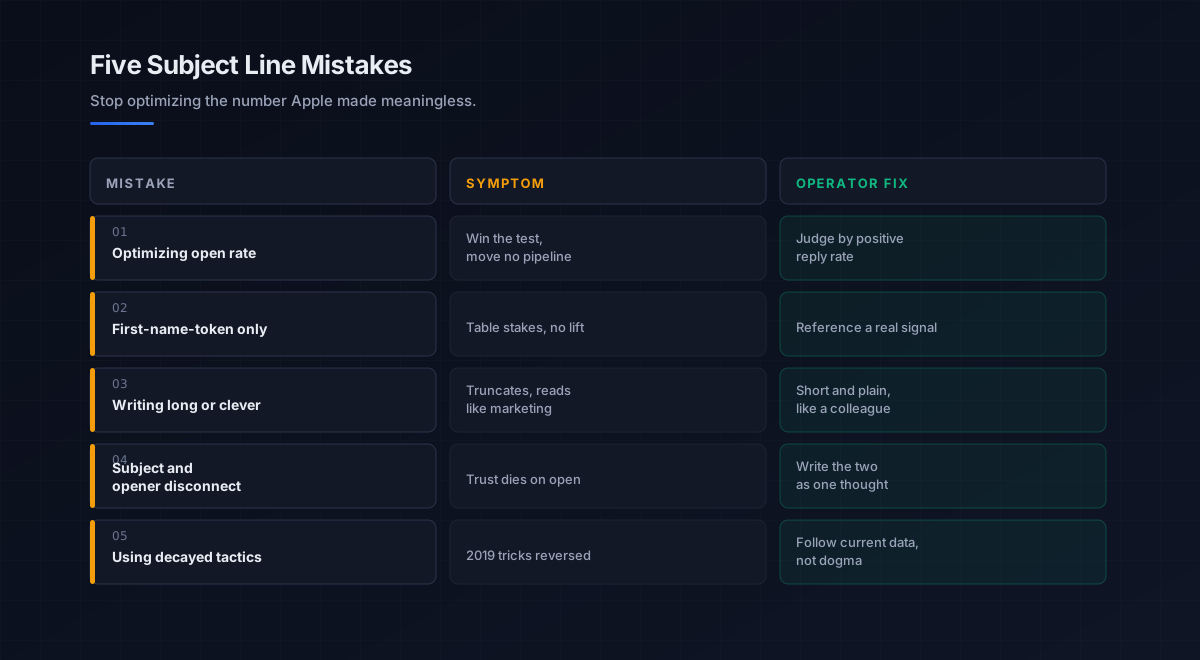
What we see most often is the same handful of errors that tank opens or, worse, opens that never convert.
-
Optimizing open rate. Apple inflated opens into fiction. Judge subject lines on positive reply rate, not the broken open metric.
-
First-name-token personalization. Basic tokens are table stakes now and do not move the needle. Reference a real signal, a trigger, initiative, or technology, instead.
-
Writing long or clever. Subjects over 40 characters truncate on mobile and clever ones read like marketing. Keep it short and plain, like a colleague’s note.
-
Disconnecting subject from opener. A subject that does not match the first line kills trust on open. Write the two as one continuous thought.
-
Using decayed tactics. Numbers, urgency, and “Quick question” worked in 2019 and have reversed or flattened. Follow current data and durable principles, not recycled tricks.
An eight-step framework for writing subject lines
This is the order we work through with the teams we work with when they fix subject lines. Run it top to bottom.
- Confirm deliverability first. If 17 percent never arrive, fix list hygiene and authentication before touching copy.
- Switch your scoreboard. Measure positive reply rate, not open rate, since Apple broke open tracking.
- Source a real signal. Find a trigger, observation, or shared context per prospect to anchor the subject.
- Keep it under 40 characters. Shorter for executives, 1 to 5 words, so it displays fully on mobile.
- Pick one job. Curiosity, relevance, named pain, or reference, not all four. Plain and specific beats clever.
- Match the opener. Write the subject and first line as one continuous thought so the open is not betrayed.
- Test four to five variants. Change one element at a time, and judge on positive reply rate over a meaningful sample.
- Send Tuesday to Thursday morning. Use the 8 to 11 AM local window, and keep iterating on the principle, not the trick.
How subject lines fit the broader stack
Subject lines are the open-rate layer of the cold email channel, which is one channel of outbound. Each connects to a deeper guide.
- The cold email playbook. Strategy, deliverability, and metrics in the cold email pillar.
- The templates. The body the subject must match, in cold email templates.
- The tooling. Sending, testing, and rotation, in cold email software.
- Deliverability. What gets the email into the inbox to be opened, on email deliverability.
- Sender reputation. Keeping the domain trusted, on sender reputation.
- Signals. The intent that powers real subject personalization, in sales intelligence tools.
- The data layer. Clean contacts so the email arrives, in data enrichment tools.
- Strategy. The motion the subject serves, in outbound sales.
That is the map. Deliverability earns the inbox, the signal makes the subject relevant, the short honest line earns the open, and continuity with the body turns that open into a reply that actually counts.
Frequently asked questions
What makes a good cold email subject line in 2026?
How long should a cold email subject line be?
Does personalizing the subject line improve open rates?
Why are my open rates high but replies low?
Should I use numbers or emojis in cold email subject lines?
What is the best time to send cold emails for opens?
How many subject line variants should I test?
The bottom line
Cold email subject lines in 2026 win on being short, signal-driven, and continuous with the opener, and they are judged by positive reply rate rather than the open rate Apple broke in 2021. The personalization that lifts results references a real trigger or observation, not a first-name token, and the tactics that worked in 2019, numbers, urgency, “Quick question”, have decayed, so the durable principles matter more than any trending format. Keep it under 40 characters, make it read like a colleague, and match it to the first line.
If you take one rule from this guide, make it this: stop optimizing the number Apple already made meaningless. A subject line’s job is to get the right person to open with the right expectation so the body can convert, not to win a vanity open-rate test. Confirm the email can reach the inbox, anchor the subject to a real signal, keep it short and honest, and measure the only metric that still tells the truth, replies that move pipeline.
Get the operator playbook in your inbox. The Outbound Game publishes one operator-grade breakdown a week on B2B outbound sales, tactics, tooling, and ops. No fluff, no vendor talking points. Subscribe and get the next one when it ships.
More on Cold Email
Cold Email Call to Action: What Converts in 2026 (Data)
Cold email call to action data for 2026: why interest CTAs win cold, when specific time asks take over, and the ladder that escalates across a sequence.
How to Respond to Cold Email Replies (2026 Playbook)
How to respond to cold email replies in 2026: the six reply lanes, the speed windows that decide conversion, and the plays that turn replies into meetings.
How to Follow Up on Cold Emails in 2026 (What to Send)
How to follow up on cold emails in 2026: the day by day map, what each touch should say, breakup emails that earn replies, and when to stop.