Cold Email Templates That Get Replies in 2026, Tested
Cold email templates that get replies in 2026, with the framework behind each. An operator guide to structure, signal personalization, and follow-ups.
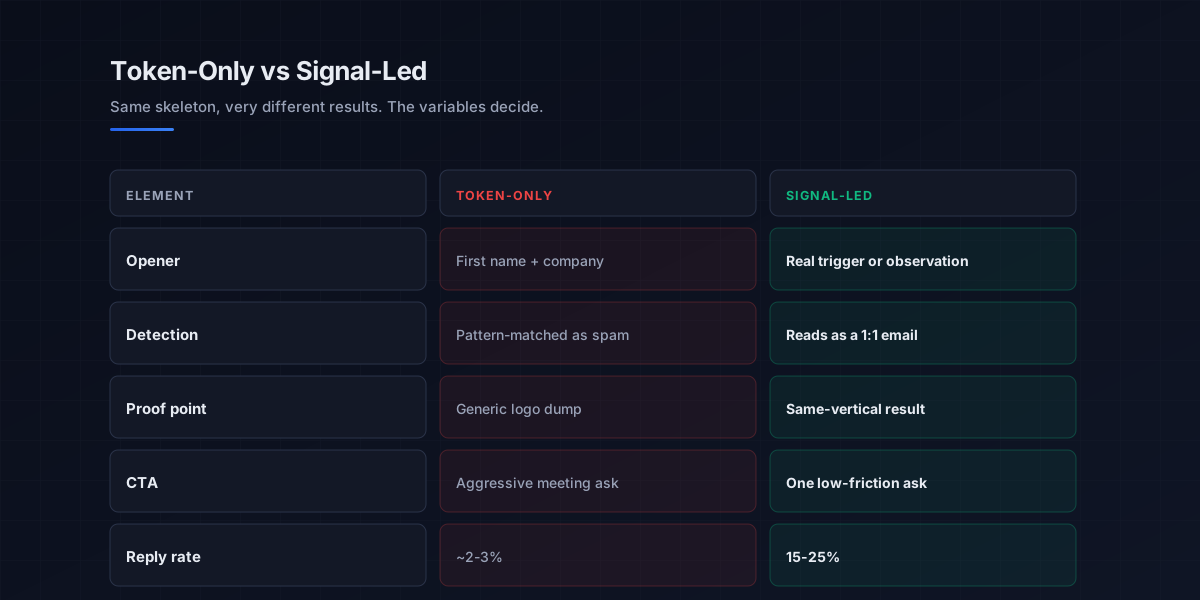
Cold email templates are starting points, not scripts, and getting that one distinction right separates the teams clearing 15 to 25 percent reply rates from the average sender stuck at 3.43 percent. The structure of a high-performing email barely changes: a specific opener, a problem-solution statement, a proof point, and one low-friction ask. What changes is the content you pour into that structure, the trigger event, the pain language, the proof point, and those have to be real and specific to the prospect. Fill in the company name and first name and call it done, and you have a template that performs exactly like a template.
That is the whole game in 2026, and it got harder for a specific reason: LLM-generated personalization made obviously-templated copy trivially easy to detect and ignore. Buyers and spam filters both pattern-match against the generic “Hi there, I help companies like yours” opener instantly. So the cold email templates that work now are not clever wording, they are reusable structures with real signal injected into them. This guide gives you the frameworks, usable templates by use case, and the follow-up sequence behind them, all built on what actually gets replies this year.
This is the copy layer of the cold email pillar, which covers the deliverability and targeting that decide whether these templates ever reach an inbox, and a companion to the cold email software comparison for sending them at scale. A perfect template in the spam folder still converts at zero, so the email deliverability work comes first.
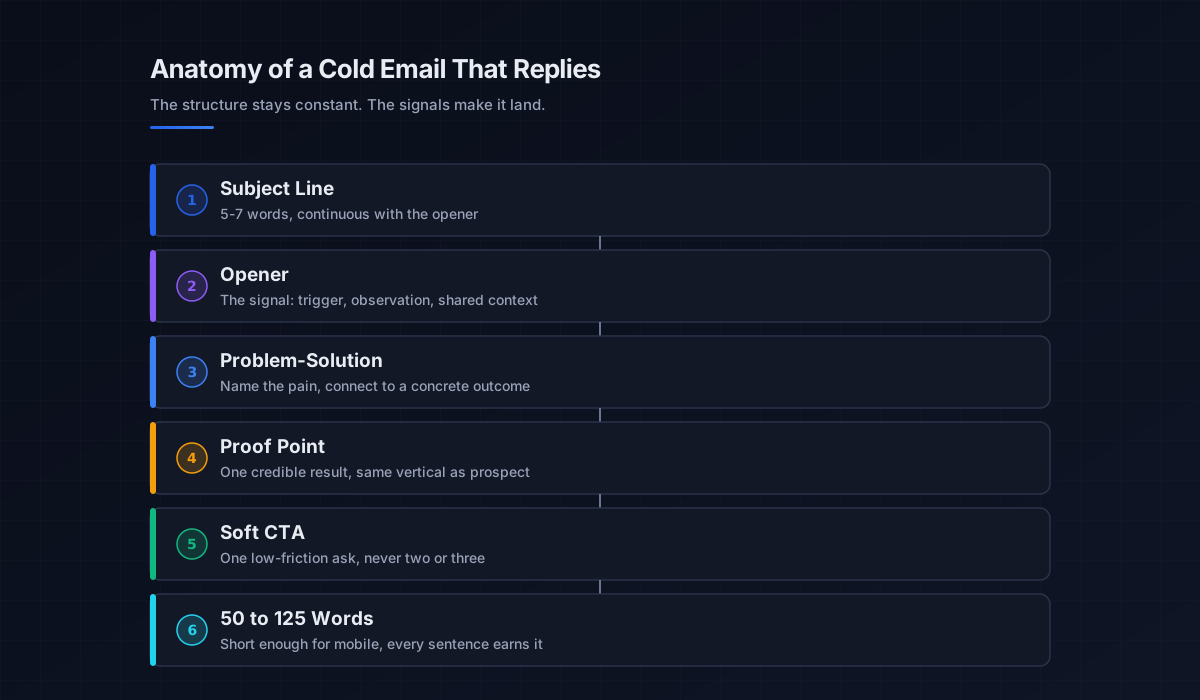
The five-part structure behind every template
Before any specific template, internalize the structure, because every high-performing cold email follows the same five parts. Master the skeleton and you can write a template for any situation rather than memorizing a swipe file.
Subject line
Five to seven words, specific, and continuous with the first line so the two feel like one thought. A subject that says one thing while the email opens on another loses the reader immediately. Avoid all caps, special characters, and anything that reads like marketing.
Opener
The most important sentence in the email, and it must be about the prospect, not you. This is where the signal goes: a trigger event, a shared experience, or a specific observation. “Your engineering team grew 40 percent this quarter” beats “I hope this email finds you well” by an enormous margin, because the first could only have been written for this one person.
Problem-solution statement
Name the problem the trigger implies, then connect it to an outcome you create, in concrete terms. Lead with the prospect’s pain, not your product’s features. Specificity wins: a named metric and a real outcome outperform vague value claims every time.
Proof point
One piece of credible social proof, ideally a customer in the same vertical as the prospect. “We helped another B2B SaaS company cut onboarding time 30 percent” lands harder than a generic logo dump, because relevance is the proof, not volume.
The soft CTA
One ask, never two or three, and low-commitment. Low-friction asks (“worth a quick look?”) get roughly twice the replies of aggressive meeting demands (“got 30 minutes Tuesday?”). The first email’s job is a reply, not a booked calendar slot.
Keep the whole thing between 50 and 125 words. Emails under 50 words lack the context to be compelling; over 200 words lose the reader on mobile. Every sentence earns its place.
Cold email templates by use case
Here are usable cold email examples and templates built on that structure, with the reasoning behind each. Treat the bracketed parts as signals to fill with real research, not tokens to mail-merge. These are b2b cold email templates you adapt, not scripts you blast.
The trigger-event template
Subject: [Company] + [their recent move]

Hi [First name], saw [Company] just [specific trigger,
e.g. raised a Series B / opened a London office]. Teams
hitting that stage usually run into [specific problem the
trigger creates].

We helped [similar company in their vertical] handle exactly
that, [concrete outcome, e.g. cut ramp time 30%].

Worth a quick look at how?
This is the highest-performing structure in 2026 because the trigger makes it timely rather than random. The trigger is the signal, and without one the template feels generic no matter how polished the wording.
The observation template
Subject: quick thought on [their specific process]

Hi [First name], noticed [specific observation about their
website, hiring, tech stack, or content]. That usually means
[implied pain point].

Most [their role]s we talk to are dealing with [problem],
and we have a specific way to fix it that got [proof point].

Open to a quick note on it?
This works when there is no funding-style trigger but you can observe something real. The observation does the same job as a trigger: it proves you did the homework.
The value-first template
Subject: [resource] for [their team/goal]

Hi [First name], put together [a genuinely useful resource,
e.g. a benchmark, checklist, or teardown] for [their role]s
working on [goal]. No ask, just thought it would be useful
given [context].

Happy to send it over, want me to?
Leading with value instead of a pitch lowers the prospect’s guard. The resource has to be genuinely useful, a real template, benchmark, or teardown, not a thin lead magnet.
The breakup follow-up template
Subject: closing the loop

Hi [First name], I have not heard back, so I will assume
the timing is not right. If [problem] becomes a priority
later, I am easy to find.

One quick favor, if someone else on your team owns [area],
I would appreciate a pointer in their direction.
The breakup email, asking who else to speak to, consistently outperforms other follow-ups on reply rate, because it removes pressure and opens a referral path. It is the single most reliable follow-up template in the set.
Proven copywriting frameworks to build on
When you need to write a template from scratch, lean on a proven cold email framework, the structures that predate cold email and still work. PAS, problem, agitate, solve, names the prospect’s problem, sharpens why it matters, then offers the fix; it suits pain-driven outreach. AIDA, attention, interest, desire, action, opens with a hook, builds interest with a relevant claim, creates desire with proof, and closes with the ask; it suits a clear, compelling offer. BAB, before, after, bridge, paints the current painful state, the improved future state, and your solution as the bridge between them.
These are not competing with the five-part structure, they are ways to fill it. The cold email copywriting that converts in 2026 uses a framework to organize the message and real signals to make it land. A framework without a signal is still a generic template; a signal without a framework is a disorganized one. You need both, which is why the sales intelligence tools layer that surfaces signals matters as much as the copy itself.
The follow-up sequence that captures the other half
A single email forfeits roughly 42 percent of your potential replies, since follow-ups capture them, so templates only work inside a sequence. The standard high-performing cadence is five to seven touches over about two weeks, and crucially it should go multichannel rather than email-only. A representative sequence: day one initial outreach (trigger or observation template), day two a LinkedIn connection request with no pitch, day four or five a value-add email (the value-first template), day seven LinkedIn engagement on their content, then a check-in, and finally the breakup email.
Match follow-up frequency to your list size: large lists need longer gaps, small lists need touches the prospect finds useful even before they are ready to buy. Each cold email follow up should add something, a new angle, a resource, a different proof point, never just “bumping this to the top of your inbox.” The mechanics of running this across channels live in the cold calling and LinkedIn outreach playbooks, coordinated under the broader outbound sales motion.
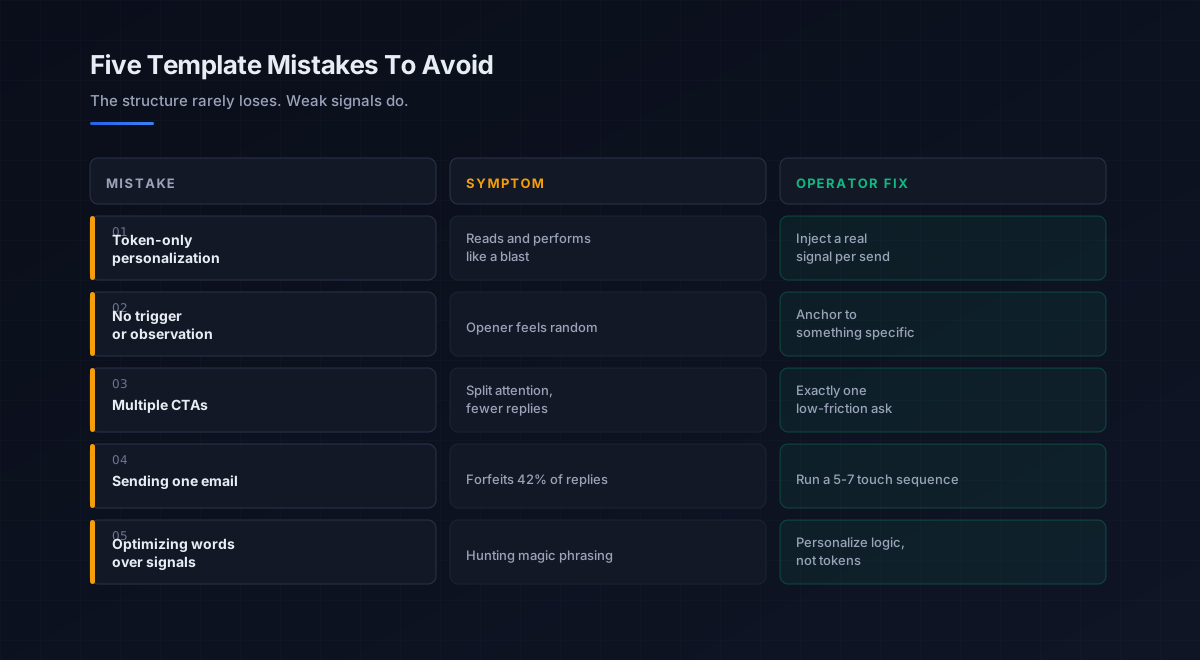
Five mistakes that make templates fail
What we see most often is the same handful of errors that turn a good template into a generic blast.
-
Token-only personalization. Filling in first name and company and nothing else produces a message that reads and performs like a template. Inject a real trigger, observation, or signal instead.
-
No trigger or observation. A template without a reason for the timing feels random. Anchor every opener to something specific and real about the prospect.
-
Multiple CTAs. Two or three asks split attention and cut replies. Use exactly one low-friction CTA per email.
-
Sending one email and stopping. A single send forfeits about 42 percent of replies. Run a 5 to 7 touch multichannel sequence, ending with the breakup email.
-
Optimizing words over signals. Hunting for magic phrasing while ignoring research is backwards. The structure rarely loses; weak or missing signals do. Personalize the logic, not just the tokens.
An eight-step framework for using cold email templates
This is the order we build template-driven outreach in, for our own sends and for the teams we work with. Run it top to bottom.
- Confirm deliverability first. A template only works from an authenticated, warmed domain on a verified list. Fix infrastructure before copy.
- Pick five strong frameworks. Five proven structures beat fifty generic ones. Master the five-part skeleton and a couple of copywriting frameworks.
- Source a real signal per prospect. A trigger, observation, or shared context. No signal, no send.
- Write the opener around the signal. Make the first line about them, not you, and continuous with the subject.
- Keep it 50 to 125 words, one CTA. Short enough for mobile, with a single low-friction ask.
- Build a 5 to 7 touch sequence. Multichannel, each touch adding value, ending with the breakup email.
- Personalize manually, then scale. Hand-personalize the first 50 to 100 a week, then use AI only after the structure is proven.
- Measure reply and positive-reply rate. Judge templates on replies that map to pipeline, and cut the ones below your baseline.
How cold email templates fit the broader stack
Templates are the copy layer of the cold email channel, which is one channel of outbound. Each connects to a deeper guide.
- The cold email playbook. Strategy, deliverability, and metrics in the cold email pillar.
- The tooling. Sending and sequencing at scale, in cold email software.
- Deliverability. What gets the template into the inbox, on email deliverability.
- Sender reputation. Keeping the sending domain healthy, on sender reputation.
- Signals. The intent that powers real personalization, in sales intelligence tools.
- The data layer. Clean, verified contacts to send to, in data enrichment tools.
- Multichannel. Coordinating with phone and LinkedIn, in cold calling and LinkedIn outreach.
- Strategy. The motion the templates serve, in outbound sales.
That is the map. Deliverability earns the inbox, the data supplies the contacts, signals make the template land, the structure organizes the message, and the sequence captures the replies a single send would miss.
Frequently asked questions
What makes a cold email template get replies in 2026?
How long should a cold email be?
What is the best cold email structure?
How many follow-ups should a cold email sequence have?
Why do my cold email templates not work?
Should I use AI to write cold emails?
What is a breakup email and why does it work?
The bottom line
Cold email templates work in 2026 when you treat them as reusable structures filled with real signals, not as scripts to blast. The five-part skeleton, subject, signal-driven opener, problem-solution, same-vertical proof, and one soft CTA, stays constant, while the trigger, pain language, and proof must be specific to each prospect. Keep emails 50 to 125 words with a single low-friction ask, and run them inside a 5 to 7 touch multichannel sequence that ends with the breakup email.
If you take one rule from this guide, make it this: personalize the logic, not just the tokens. The structure rarely loses, weak or missing signals do, so the lever was never the wording. It is the research behind it. Pick five strong frameworks, inject a real signal into every send, confirm the template can actually reach the inbox, and the same skeleton that performs at 2 percent generic starts clearing the top-quartile reply rates instead.
Get the operator playbook in your inbox. The Outbound Game publishes one operator-grade breakdown a week on B2B outbound sales, tactics, tooling, and ops. No fluff, no vendor talking points. Subscribe and get the next one when it ships.
More on Cold Email
Cold Email Call to Action: What Converts in 2026 (Data)
Cold email call to action data for 2026: why interest CTAs win cold, when specific time asks take over, and the ladder that escalates across a sequence.
How to Respond to Cold Email Replies (2026 Playbook)
How to respond to cold email replies in 2026: the six reply lanes, the speed windows that decide conversion, and the plays that turn replies into meetings.
How to Follow Up on Cold Emails in 2026 (What to Send)
How to follow up on cold emails in 2026: the day by day map, what each touch should say, breakup emails that earn replies, and when to stop.